
Trip and mower hazard
A stump at or just above ground level catches feet, mower blades and strimmer heads without warning.
Stump grinding & treatment
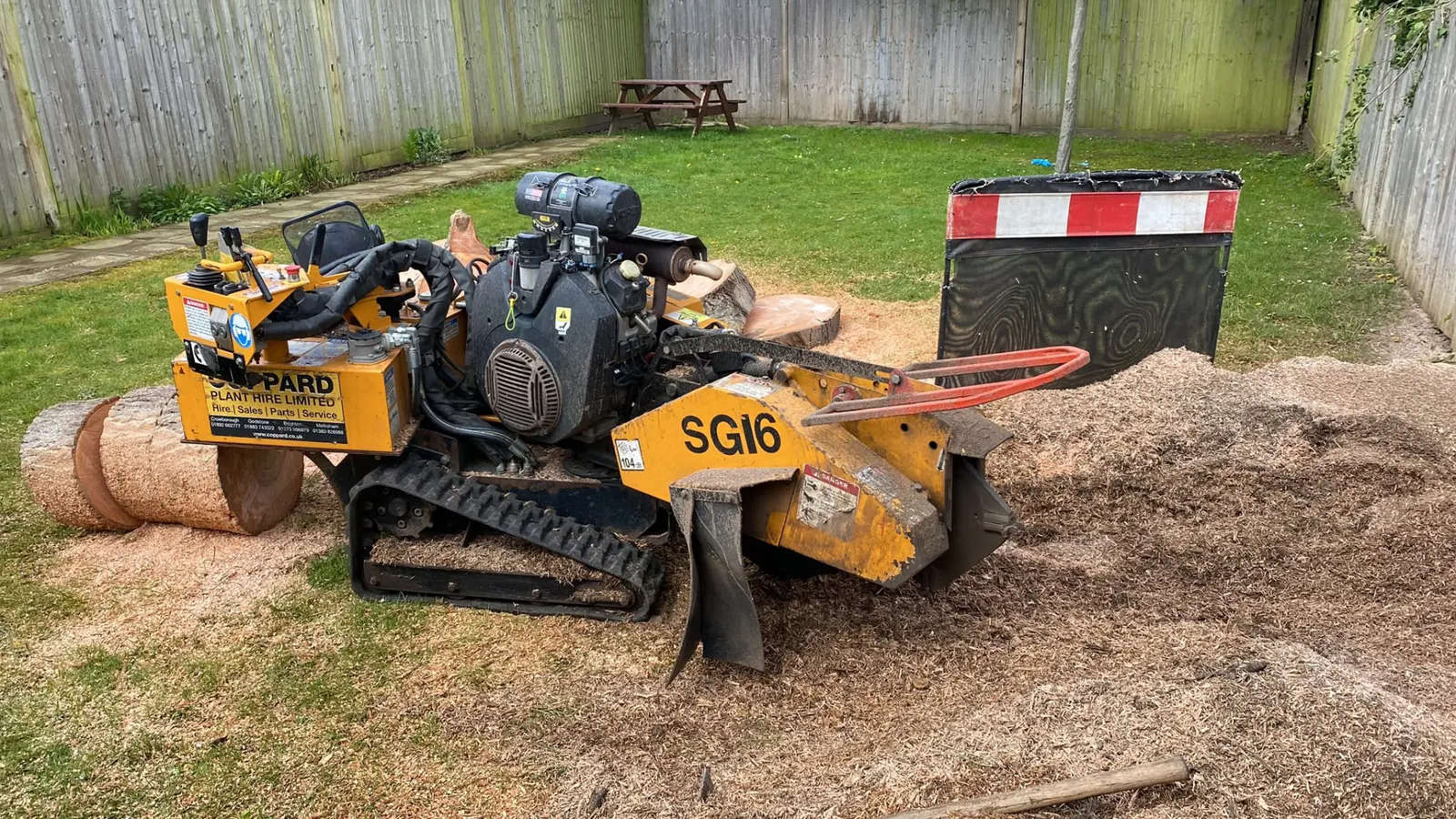
A stump left in the lawn is not a finished job, it is an unfinished one, a trip hazard, a mower obstacle, and in some species a launchpad for years of suckering regrowth. We grind it down below ground level with a tracked or towable grinder sized to the access, chip and clear the arisings, and leave the ground ready for turf, planting or paving.
12 years grinding stumps across the borders, 59+ five-star Google reviews, £10m employers' and £5m public liability cover.
12 yrs
Experience grinding stumps of every size and species
£15m
Total insurance cover, £10m employers', £5m public and products
NPTC
City & Guilds certificates held by the crew on site
7 days
Typical wait for a free site visit, written quote sent same day
The service
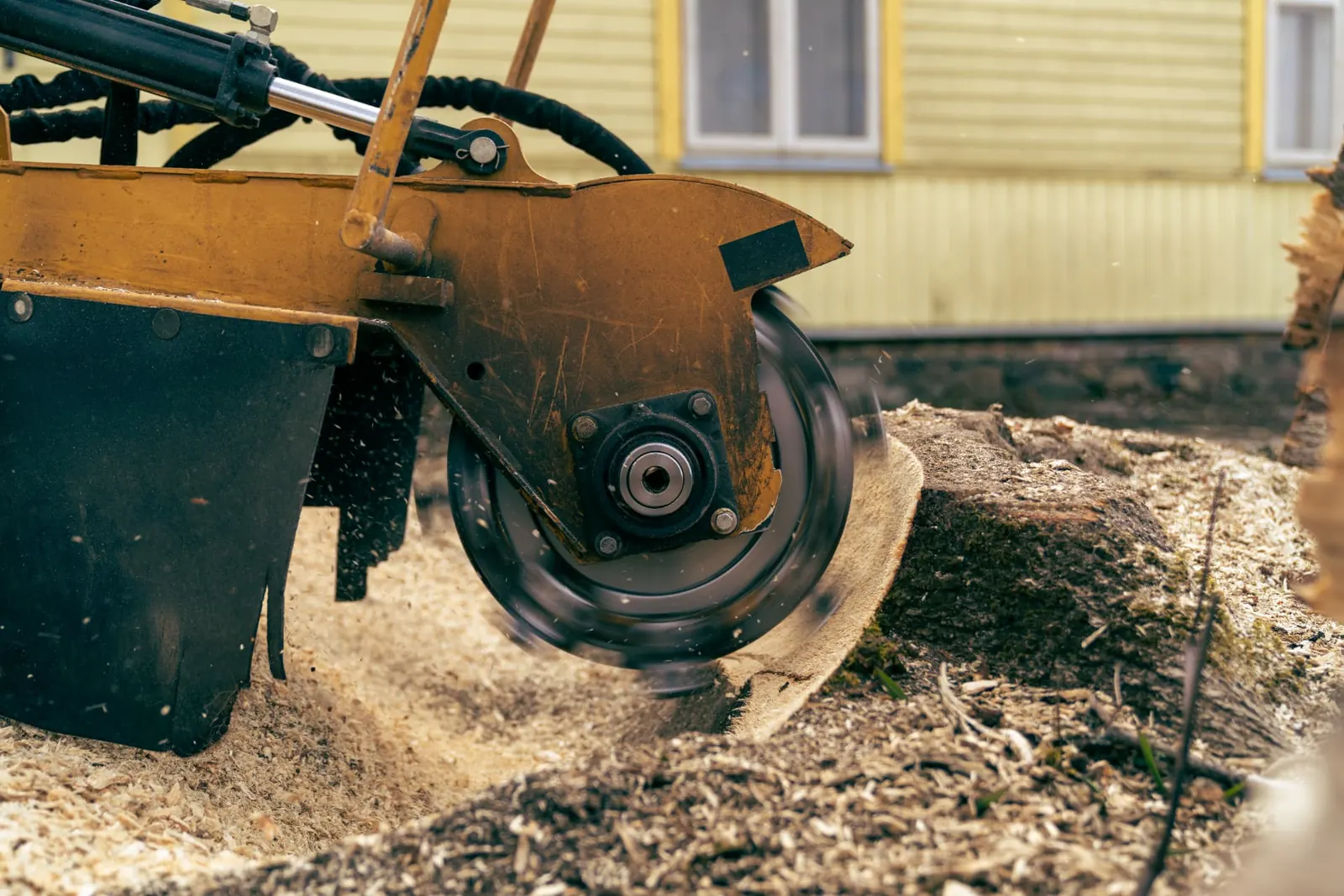
Stump grinding uses a machine with a rotating toothed wheel to chew the stump and the top of the root plate down into loose woodchip, working from the outside edge inward until the stump is below ground level rather than merely flush with it. The depth we can reach depends on the machine and the access, a compact tracked grinder can get through a standard side gate and work a stump down to a genuinely plantable or turfable depth, where a garden with no side access at all may call for a smaller, more manoeuvrable unit and a slower job.
It is for anyone left with a stump after a tree has come down, whether we removed it or someone else did years ago, and it is for anyone about to relandscape, turf, pave or plant over the spot. Landscapers and groundworkers ask for it before laying a patio or driveway edge; homeowners ask for it because a stump in the middle of a lawn is exactly where the mower catches, and because certain species will keep sending up shoots from the root plate for years if the stump is simply left.
Left in the ground, a stump is not inert. Species that sucker aggressively, poplar, willow, cherry, lime and false acacia among them, will throw up regrowth from the root plate season after season, and a decaying stump close to a building or a healthy tree carries a real risk of honey fungus, or Armillaria, spreading through the root system to neighbouring plants. Where access allows the grinder in, grinding is the more permanent answer; where it does not, chemical stump treatment is the alternative for stopping regrowth without excavation.
Homeowners relandscaping a garden, landscapers and groundworkers preparing a site, and anyone left with an old stump from previous tree work.
Before turfing, planting or paving over the area, where a stump is a trip or mowing hazard, or where suckering regrowth keeps returning.
Grinding below ground level with a machine sized to the access, chippings cleared or left as backfill on request, and the site tidied.
Where grinding access is impossible, chemical stump treatment is available to stop regrowth without excavation.
What happens if it's left
A stump sitting flush with the lawn looks like the smallest job left on the list, which is exactly why it gets put off. But the practical problems it causes rarely stay small. A mower blade meeting a hidden stump edge can be written off in a second, and a stump a few inches proud of the grass is a genuine trip hazard for children, visitors and anyone crossing the garden after dark.
The biological problems run quieter and longer. A decaying stump is a route for Armillaria, honey fungus, to establish and then spread through root contact into neighbouring shrubs, hedges and even healthy trees, by the time the tell-tale bootlace-like rhizomorphs or the honey-coloured toadstools show up, the fungus has often been working underground for a while. Species that sucker do the opposite of dying quietly: cherry, lime, willow, poplar and false acacia will keep sending shoots up around the base for years, turning one stump into a spreading thicket if it is ignored.
The common mistakes we see are trying to burn a stump out with a fire that scorches nearby fencing and never actually removes the root plate, hiring a domestic-grade rented grinder that cannot reach useful depth and leaves a shallow saucer that regrows within a season, and paving or turfing straight over a stump without treating it, only to have the surface crack or subside as the wood rots away underneath.
A stump at or just above ground level catches feet, mower blades and strimmer heads without warning.
Armillaria can establish in a decaying stump and spread by root contact into nearby healthy trees and shrubs.
Species like cherry, lime, willow and poplar send up new shoots from the root plate for years if left.
Turf, paving or a new bed laid over an untreated stump will crack, sink or die back as the wood rots beneath it.
A saucer-shaped grind that does not reach real depth still regrows and still leaves a lump under new turf.
The wrong machine forced through a narrow gap can mark paving, lawns and fences on the way in.
What you get
Genuine grinding depth means the area is actually ready to turf, plant or pave, not just tidier to look at.
Removing the growing point at the root collar stops suckering species sending up new shoots.
Compact tracked grinders reach most side-gate gardens; where they can't, chemical treatment covers it instead.
Removing decaying stump material near other planting lowers the chance of Armillaria taking hold.
Chippings cleared as standard, or left deliberately as backfill or mulch if you'd prefer to keep them.
A properly ground stump leaves a level, plantable surface rather than a lump waiting to reappear.
Two stumps that look identical from the kitchen window can be completely different jobs once you account for what's underneath, what's around them, and what happens next. Here is what actually changes the method and the outcome.
The right machine for a stump in an open field is not the right machine for a stump three feet from a conservatory down a narrow side return. Compact tracked grinders can fit through a standard gate and work in tight courtyards and small rear gardens across Oxted, Caterham and Godstone; larger towable units cover bigger stumps and open ground more quickly on driveways and paddocks around Edenbridge and Lingfield.
Access width, gate position, gradient and anything the machine has to cross to reach the stump, a lawn, a patio, a flower bed, all get checked at the site visit, because forcing an oversized machine through a gap it doesn't fit is how paving gets chipped and lawns get scarred.
Grinding below ground level means removing the growing point at the root collar, not just shaving the visible stump flush with the grass. Depth achievable depends on root plate size, soil type and any obstructions in the ground such as old paving, drain runs or services, all of which get checked before the machine starts, since a grinder wheel meeting a buried pipe or cable is a problem nobody wants.
For a spot destined for turf or a border, a moderate depth with the hole backfilled with chippings and topsoil is usually enough. For a patio, driveway edge or anywhere load-bearing, we recommend going deeper and having a groundworker follow up with proper compaction, tell us the end use at the quote stage and we'll grind to suit it.
Species changes both the grinding effort and the aftercare. Oak and beech stumps are dense and slower to grind through; conifer stumps like leylandii grind quickly but the roots can spread wide and shallow. Poplar, willow, cherry, lime and false acacia sucker aggressively from any root left in the ground, so for these we grind out as much of the root collar and near-surface root plate as access allows, since a smaller fragment left behind can still throw up shoots.
Where a stump has been decaying for a long time already, the wood is soft and grinds fast, but soft decaying wood close to a fence, hedge or other planting is exactly the situation where honey fungus, Armillaria, has had the chance to establish. Grinding it out and clearing the debris reduces that risk; leaving it in place does not.
Where a grinder genuinely cannot reach a stump, through a house, over a wall, or in a spot with no safe access for the machine, chemical stump treatment is the fallback. It targets the stump and root system to stop regrowth and encourage the wood to break down over time, without any excavation or machinery on site.
It suits stumps where the ground itself isn't needed straight away for turf or paving, since the stump stays in place while it breaks down rather than disappearing immediately. We'll tell you honestly at the quote stage which method fits your access and your timeline, rather than defaulting to whichever is easier for us.
Grinding produces a genuine volume of loose woodchip and soil mixed together. Some customers want it cleared entirely so the area is ready to turf straight away; others are happy to have it raked out as mulch around borders or left in the hole as backfill, which settles over the following weeks as it decomposes.
If you're planning to plant a new tree or shrub near the old stump position, it's worth mentioning that at the quote stage, leftover woodchip and decomposing root material can affect nitrogen levels in the soil immediately around it for a season, so we can advise on spacing or backfilling with fresh topsoil instead.
Questions
Related work
A tree that has outgrown its garden, died back, or started leaning over a roof does not get cheaper or safer to deal with.
A plot that has been left to itself for a few years stops being a garden and starts being a problem: self-seeded ash and sycamore, brambles through a hedge line, a fallen willow half-buried in ivy.
Planting a tree that thrives in ten years' time starts with picking the right species for your soil, not the nicest one in the nursery photo.
We cover Oxted, Westerham, Edenbridge, Sevenoaks, Biggin Hill, Bromley, Tunbridge Wells, Redhill and the surrounding villages, see the towns our tree surgeons cover across Surrey and Kent, browse all tree surgery services, read about Jack and the crew, or go straight to the free tree surgery quote form.
Free quote
Send the form or call 07375 701290 and we'll book a free site visit, usually within 7 days, with a written itemised quote sent the same day, no obligation, no follow-up sales call.
Call 07375 701290Five Pebble Hill Cottages, Westerham Road, RH8 0EA · Mon–Sat 8am–9pm · Sunday closed