Rising cost with delay
Every year of growth adds girth, height and volume of brash, turning a straightforward clear into a bigger job with a bigger chipper bill.
Site clearance
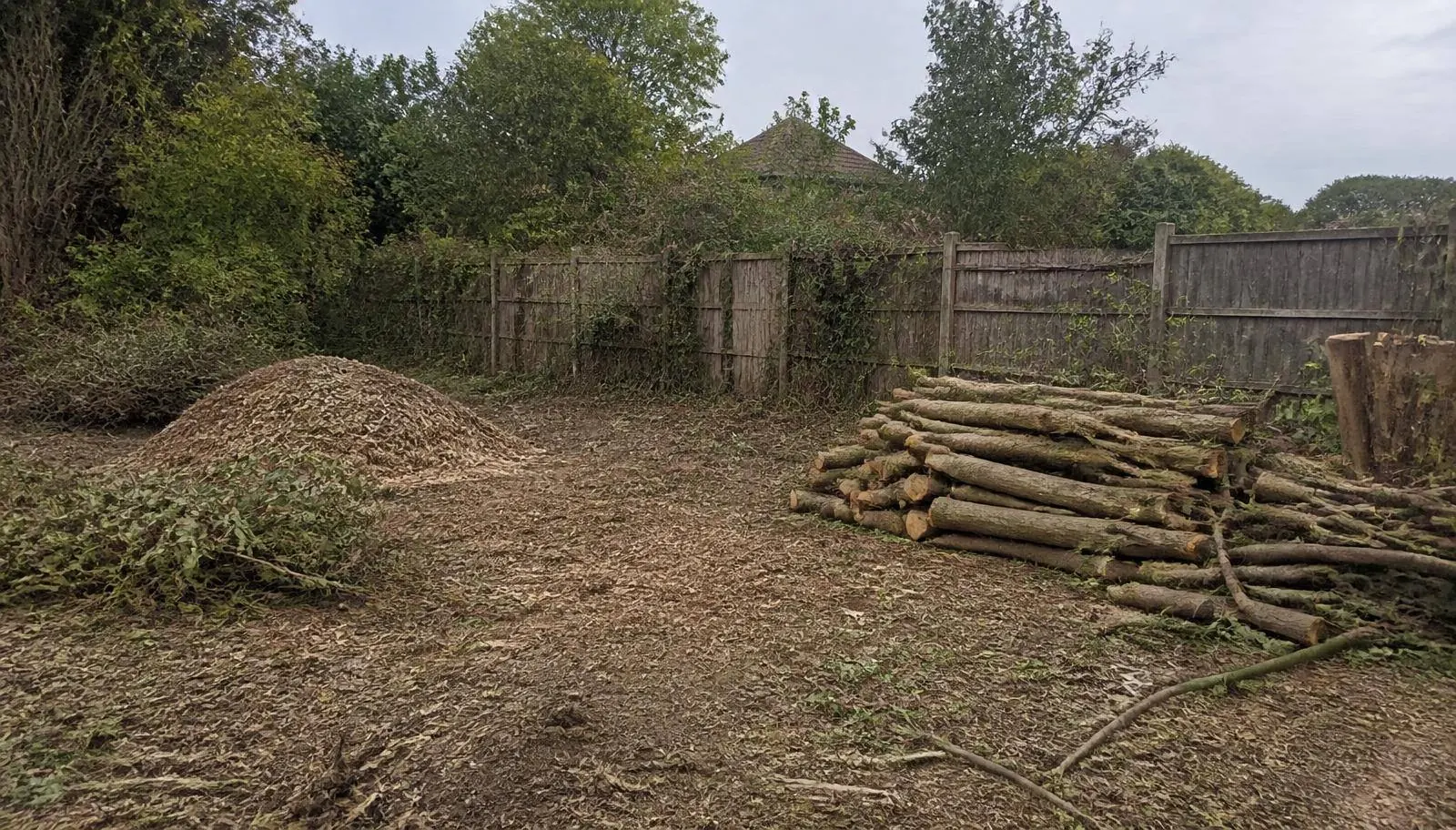
A plot that has been left to itself for a few years stops being a garden and starts being a problem: self-seeded ash and sycamore, brambles through a hedge line, a fallen willow half-buried in ivy. We clear it back to bare, usable ground, trees down, stumps out or ground level, arisings chipped and taken away.
12 years clearing overgrown plots, 59+ five-star Google reviews, £10m employers' and £5m public liability cover.
12 yrs
Clearing overgrown gardens, boundaries and building plots
£15m
Total insurance cover, £10m employers', £5m public and products
NPTC
City & Guilds certificates in felling, climbing and aerial rescue
7 days
Typical wait for a free site visit, with the written quote the same day
The service
Site clearance covers a wider job than a single tree removal: it is the systematic take-down of everything self-set, overgrown or in the way across a plot, boundary or paddock edge, self-seeded saplings, dense scrub, overgrown hedgerows gone leggy, ivy-smothered stems, and any dead or leaning trees mixed in among it. Jack walks the site first and works out what stays, what comes out, and what order it needs doing in, because a boundary hedge, a mature oak and a stand of self-seeded ash are three different jobs stitched together into one visit.
It is the job people call for before groundworks start on an extension or a new drive, before a garden gets landscaped from scratch, when a plot has been inherited or bought and left wild for a decade, or when a boundary hedge and its self-set understorey have swallowed a fence line. Farms and smallholdings around Edenbridge and Godstone use it to reclaim paddock margins; developers and builders around Crawley and Redhill use it to hand a groundworker a clean, level site rather than one still full of stumps and root plates.
The reason to bring in a qualified crew rather than a hired mini-digger and a strimmer is the same reason as any other tree work: mixed scrub often hides mature stems, old fence wire, and trees with genuine structural problems under the ivy. Jack holds NPTC and City & Guilds certificates in felling up to 380mm, chainsaw maintenance and cross-cutting, and tree climbing and aerial rescue, and the work is covered by £10m employers' liability and £5m public and products liability, which matters when a plot has not been touched, or properly inspected, in years.
Homeowners with an overgrown garden, developers and builders, farms and smallholdings, and landlords taking back a neglected plot.
Before groundworks or landscaping, on inherited or long-neglected plots, and where a boundary hedge and self-seeded trees have merged into one overgrown line.
Felling of unwanted trees and scrub, stump removal or grinding, and all arisings chipped and cleared from site.
If any tree on site carries a TPO or sits in a conservation area, we make the application to the council on your behalf before work starts.
What happens if it's left
Scrub and self-seeded trees do not sit still. Every season they are left, sycamore and ash seedlings put on another ring of girth, brambles thicken into rope-like stems that need a chainsaw rather than shears, and ivy climbs another metre up whatever it has found. What would have been a day with loppers and a strimmer three years ago is a two-day job with a chipper today, and the price moves with it.
It also hides problems. A dead elder or a leaning ash wrapped in ivy looks like part of the hedge until the ivy is stripped back and the actual condition of the stem is visible, by which point it may already be a hazard to whoever has been walking past it. Overgrown boundaries are also where old fence wire, buried rubble and forgotten stumps turn up, all of which can stop a digger or a landscaper dead on day one if nobody has cleared the ground first.
The most common mistake is hiring general garden labour or a landscaper to 'clear the plot' with no chainsaw ticket, no insurance and no plan for what is actually a mature tree buried in scrub. It usually ends with an unfinished job, stumps left in the ground that then have to be dug out separately, or, worse, a protected tree cut down without anyone checking whether it carried a TPO first.
Every year of growth adds girth, height and volume of brash, turning a straightforward clear into a bigger job with a bigger chipper bill.
Dead or leaning stems hidden under ivy and scrub are not visible until the growth is stripped back, by which point they may already be unstable.
Buried stumps, root plates and old fence wire under overgrowth can stop groundworks or landscaping dead on the first day.
Overgrown hedges and self-set trees encroaching over a boundary line are a common source of formal complaints once a plot is finally noticed.
Felling a protected tree hidden inside overgrown scrub without checking for a TPO first is an offence, whatever the surrounding growth looked like.
Unqualified labour will often clear the easy scrub and leave the mature stems and stumps, meaning a second contractor and a second bill.
What you get
Trees, scrub and hedgerow understorey handled in one visit rather than juggling separate contractors for each element.
Stumps ground below level and root plates cleared so a digger or landscaper can start without surprises underground.
All brash and timber chipped and taken away as part of the job, not left in a pile for you to deal with.
Any tree with a TPO or in a conservation area is identified and the application handled before a saw touches it.
£10m employers' and £5m public and products liability cover, held by the crew doing the actual cutting.
A plot that was unwalkable and overgrown becomes level, open ground, ready to plant, landscape or build on.
No two overgrown plots are the same shape underneath the growth, and clearance is as much about working out what is actually there as it is about cutting it down. Here is what actually shapes the job.
The first hour on any clearance job is spent walking the boundary and working out what is scrub, what is a genuine tree, and what is worth keeping. A hedge line that looks like one continuous mass of green from the house often turns out to be hawthorn and blackthorn with several self-seeded ash and sycamore standing inside it, some of them fifteen years old and well past 'sapling'. Separating those out before the chainsaws start means the right method gets used on each, hand tools and a brush cutter for genuine scrub, felling technique for anything with real girth.
This stage is also when Jack identifies anything with a TPO, anything in a conservation area, and anything structurally compromised, a leaning stem, a split union, a fungal bracket at the base, that changes the plan or the order of works. On plots around Godstone and Lingfield that back onto woodland, this walk-round often turns up more mature timber hidden in the boundary than the client realised was there.
Clearance almost always runs from the boundary inward and from the largest stems to the smallest, so access stays open for the chipper and the crew is not working back over ground they have already cleared. Any mature trees earmarked for removal come down first using standard felling or sectional dismantling depending on the target zone, then the surrounding scrub and self-set saplings are cut back with chainsaws or a brush cutter.
Stumps are handled last, once the crew knows exactly which ones need grinding for future planting, paving or building work and which can simply be left low-cut. On a plot destined for landscaping or an extension, grinding depth and root plate removal are agreed with the client or their groundworker before the machine goes in, because it is far cheaper to get that right on the first pass.
Overgrown hedgerows and scrub are exactly where birds nest, and it is an offence to disturb an active nest under the Wildlife and Countryside Act. Between March and August the crew checks hedge lines and dense growth for active nests before cutting, and where one is found, work on that section is delayed until the nest is naturally vacated. This is one of the main reasons a clearance is easier and quicker to plan for autumn or winter.
Winter working also gives clearer sightlines through leafless growth, making it far easier to spot dead or structurally compromised stems hidden inside a hedge or thicket, and it does less damage to any lawn or planted areas the clearance route has to cross.
A mixed clearance produces a lot of material, brash from scrub and hedging, plus proper cordwood from any mature trees felled. All of it is chipped and cleared as standard. If you want to keep any of the timber, seasoned logs are available at £100 per tonne bag and woodchip at £50 per truck load up to 3 tonne, which is often worth having on hand if beds or paths on the newly cleared plot are about to need mulching anyway.
Large volumes of chip from a bigger clearance can also be left on site in agreement with the client, useful as a temporary ground cover or access track while further landscaping or building work is planned.
It is common for a genuinely valuable tree to be standing inside an otherwise overgrown plot, an oak that predates the scrub around it, or a specimen tree in a conservation area that the rest of the site has simply grown up around. Where that is the case, the tree is identified, checked against the local authority's TPO register, and, if consent is needed, the application is made on your behalf before any surrounding clearance work starts.
This matters because clearance work can inadvertently affect a protected tree even without cutting it directly, root disturbance from stump grinding nearby, or a change in light and wind exposure once the surrounding growth is removed, can both be relevant to a council. Flagging this at the quote stage avoids problems once the plot is opened up.
Questions
Related work
A tree that has outgrown its garden, died back, or started leaning over a roof does not get cheaper or safer to deal with.
A stump left in the lawn is not a finished job, it is an unfinished one, a trip hazard, a mower obstacle, and in some species a launchpad for years of suckering regrowth.
An overgrown leylandii or laurel hedge doesn't just look untidy, it blocks light, takes over a boundary, and can end up as a dispute with a neighbour under the High Hedges Act.
We cover Oxted, Westerham, Edenbridge, Sevenoaks, Biggin Hill, Bromley, Tunbridge Wells, Redhill and the surrounding villages, see the towns our tree surgeons cover across Surrey and Kent, browse all tree surgery services, read about Jack and the crew, or go straight to the free tree surgery quote form.
Free quote
Send the form or call 07375 701290 and we will book a free site visit, usually within 7 days. You get an honest plan for what needs to come out and what can stay, and an itemised written quote the same day as the visit.
Call 07375 701290Five Pebble Hill Cottages, Westerham Road, RH8 0EA · Mon–Sat 8am–9pm · Sunday closed