Building damage
Branches rubbing a wall or roof wear through pointing and tiles and can let damp track in behind guttering.
Lateral reduction
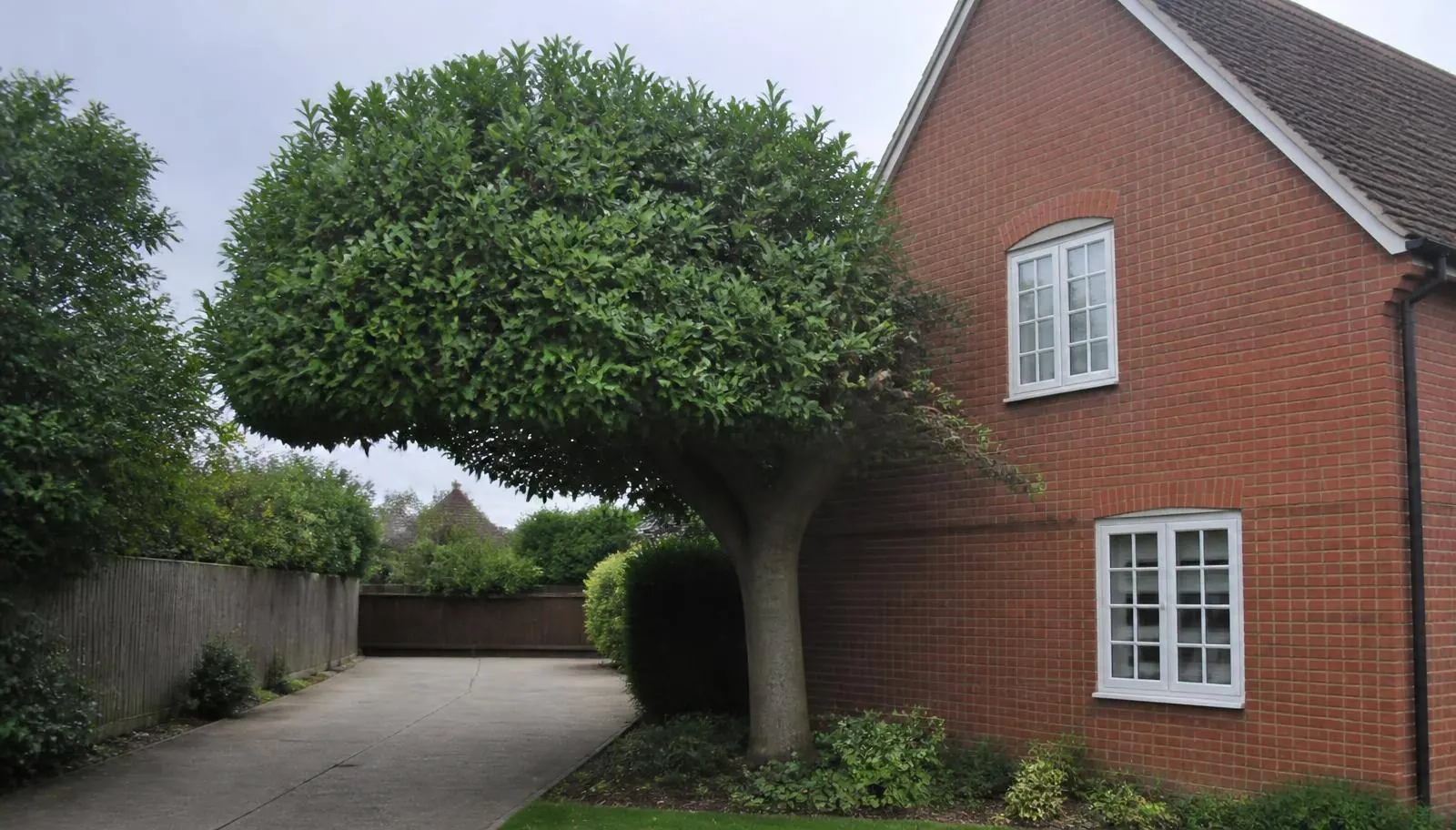
When a tree is fine everywhere except one side, pressing on a wall, tangled in an overhead line, or crowding a boundary fence, a full crown reduction is more than the problem needs. A lateral reduction cuts back growth on that one side only, restoring clearance while leaving the rest of the canopy alone.
12 years cutting to clearance targets around Sevenoaks and Tunbridge Wells, 59+ five-star Google reviews.
12 yrs
Hands-on canopy management and boundary clearance across the borders
£15m
Total insurance cover, £10m employers', £5m public and products
NPTC
City & Guilds certificates in climbing, aerial rescue and aerial cutting
7 days
Typical wait for a free site visit, with the written quote the same day
The service
Lateral reduction is a directional pruning technique: rather than reducing a tree's whole crown evenly, growth is cut back only on the side that is causing the problem, the side facing a house wall, a phone or power line, a neighbour's fence, or a shared drive, while the rest of the canopy is left untouched. Cuts are still made back to a suitable lateral branch or bud, following recognised pruning practice, so the pruned side does not end up looking flat or hacked back.
It is the right call wherever a tree is otherwise healthy and well-placed but has one flank growing into something it should not: branches brushing render or guttering in Sevenoaks, a limb reaching into an overhead cable near Tunbridge Wells, growth pushing over a boundary into a neighbour's garden in Edenbridge, or a canopy narrowing a shared driveway. In all of these cases removing the whole tree, or reducing the entire crown, would solve the specific problem at the cost of shade, screening and garden character the client actually wants to keep.
The precision this needs is exactly why it is not a job for loppers from a ladder. Working out which side to cut, how far back a given limb can go without unbalancing the tree's overall structure, and how close it is safe to work to a live overhead line all take judgement and training. Jack holds NPTC and City & Guilds certificates covering climbing, aerial rescue and aerial cutting, and the work is covered by £10m employers' liability and £5m public and products liability, cover that matters directly when the target being cleared is a house wall or a cable.
Homeowners with growth pressing on a wall or roofline, and anyone with branches near overhead cables, boundaries or shared access.
A tree that is fine overall but has one side encroaching on a building, line, fence or driveway.
Directional cuts back to suitable laterals on the affected side only, arisings chipped and cleared, and a clean finish.
TPO or conservation-area applications are submitted on your behalf where the tree is protected.
What happens if it's left
Growth pressing against a building rarely stays a cosmetic issue. Branches rubbing render or roof tiles wear through paint and pointing over a season or two, and damp can track in behind guttering that is being held slightly open by a limb wedged against it. Left long enough, that contact point becomes a repair job on the house, not just a pruning job on the tree.
Growth encroaching on overhead lines is a different order of risk. A branch resting against a live line is a fire and outage risk, and network operators will cut clearance themselves, usually with far less regard for the tree's shape or long-term health than a targeted arboricultural reduction. Getting ahead of that with a planned lateral reduction keeps the decision, and the standard of cutting, in your hands rather than theirs.
Boundary encroachment causes a slower-burning problem: a neighbour is entitled to cut back growth overhanging their side of the line to the boundary, and if they do it themselves the cut is rarely made to a suitable lateral or with any concern for the tree's balance. A lateral reduction done properly, from your side and to recognised pruning practice, avoids handing that decision to someone with no training and a pair of shears.
Branches rubbing a wall or roof wear through pointing and tiles and can let damp track in behind guttering.
Growth against a live overhead cable is a fire and outage risk, and utility crews will clear it without concern for the tree's shape.
Leaving one side unmanaged while the rest grows on can leave a tree structurally lopsided and more vulnerable in wind.
A neighbour is entitled to cut overhanging growth to the boundary themselves, often badly, and without asking first.
The longer encroachment continues, the larger the limbs needing removal become, and the harder the job gets to do cleanly.
Cutting a TPO or conservation-area tree, even on one side only, without consent is prosecutable.
What you get
Clearance is restored exactly where it is needed without reducing the whole tree unnecessarily.
The untouched sides of the canopy carry on providing the shade, privacy or shelter you value.
Cuts follow the tree's branch structure, so the reduced side does not look flat or hacked.
Contact damage to walls, roofs and cables is stopped before it turns into a repair bill.
Doing the cutting properly from your side avoids a neighbour or utility crew doing it badly instead.
Work carried out to recognised arboricultural good practice, under £10m employers' and £5m public liability cover, with TPO paperwork handled for you.
A lateral reduction lives or dies on getting the target distance and the balance of the remaining crown right. Here is how that is worked out on site.
The first job on site is establishing exactly what clearance is needed and from what, a set distance from a wall or roofline, statutory clearance from an overhead line as specified by the network operator, a boundary line agreed with a neighbour, or headroom over a shared drive. That figure drives every cut that follows; without it, a lateral reduction is just guesswork.
Clearance is rarely a flat, straight cut across the affected side. Individual limbs are assessed and shortened back to a lateral that will hold the new outer edge of the crown at, or beyond, the target distance once the tree has finished its next season's growth, because a cut made exactly to the line today will be back in contact within a year or two.
Removing significant growth from one side of a crown without care can leave a tree structurally lopsided, shifting its centre of gravity and increasing the load on the remaining, unreduced side in wind. Where the affected side carries a large proportion of the canopy, the reduction is planned in stages or combined with a lighter, complementary trim elsewhere to keep the tree in reasonable balance rather than solving one problem by creating another.
This is judged tree by tree, a naturally asymmetric tree growing towards light at the edge of a woodland near Edenbridge or Lingfield may already carry more weight on one side than a standard tree, and the reduction plan accounts for that existing structure rather than working to a generic rule.
Work near a house wall means careful management of where cut material and the climber's rigging lines can travel, protection sheeting over borders and patios, and lowering rather than dropping any piece near glass or render. Work near an overhead line requires assessing whether the branch can be safely accessed and cut by the tree crew at all, or whether the utility company needs to isolate or attend depending on the voltage and proximity involved; we make that call at the site visit rather than after a climber is already in the tree.
Boundary work is agreed with reference to the actual boundary line, not an estimate from the lawn, and where there is any ambiguity we recommend confirming the line before cutting rather than assuming, it avoids a dispute over whether growth removed was legitimately overhanging or not.
Fast-growing species, leylandii, poplar, willow and some limes, regrow quickly on the reduced side and often need a repeat lateral reduction within a few years, particularly where the target is a fixed distance from a building that will not move. Slower species such as oak and beech hold a lateral reduction for far longer, but tolerate a harder single cut less well, so the reduction is kept conservative and staged if a larger clearance distance is needed.
Ash affected by dieback changes the calculation again: brittle wood near a building or a line is a higher risk to work on, and in badly affected cases removal of the whole tree may be the safer and more honest recommendation than attempting a lateral reduction at height.
Arisings are chipped and cleared as standard, and areas close to walls, patios or a driveway are protected before cutting starts. Logs are available at £100 per tonne bag and woodchip at £50 per truck load up to 3 tonne if you would like to keep any of the material rather than have it taken away.
Where a lateral reduction is being used to manage growth near an overhead line or a boundary long-term, it is worth planning a maintenance cycle rather than waiting for encroachment to return to the same point, we flag a sensible interval at the time of the visit based on the species and how vigorously that particular tree has grown back before.
Questions
Related work
A crown that has outgrown its plot does not need the top taken off, it needs its branch length reduced back to sound growth points, in proportion, so the tree keeps its natural shape and stays healthy while it does the job of clearing a roofline, a boundary or a view.
Low limbs blocking a path, a drive, a lawnmower run or a bedroom window don't need the whole tree taking down, they need the lower canopy lifted correctly, cut back to sound wood at the branch collar, so the tree keeps its shape and its health while you get the clearance you actually need.
An overgrown leylandii or laurel hedge doesn't just look untidy, it blocks light, takes over a boundary, and can end up as a dispute with a neighbour under the High Hedges Act.
We cover Oxted, Westerham, Edenbridge, Sevenoaks, Biggin Hill, Bromley, Tunbridge Wells, Redhill and the surrounding villages, see the towns our tree surgeons cover across Surrey and Kent, browse all tree surgery services, read about Jack and the crew, or go straight to the free tree surgery quote form.
Free quote
Send the form or call and we will book a free site visit, usually within 7 days. You get a clear plan for the clearance you actually need and an itemised written quote the same day, no obligation, no sales call afterwards.
Call 07375 701290Five Pebble Hill Cottages, Westerham Road, RH8 0EA · Mon–Sat 8am–9pm · Sunday closed