Vehicle and property strikes
A branch that clips a van roof or a gutter repeatedly eventually causes real damage, and the cost lands with whoever owns the tree.
Crown raising
Low limbs blocking a path, a drive, a lawnmower run or a bedroom window don't need the whole tree taking down, they need the lower canopy lifted correctly, cut back to sound wood at the branch collar, so the tree keeps its shape and its health while you get the clearance you actually need.
12 years in the canopy, 59+ five-star Google reviews, £10m employers' and £5m public liability cover.
12 yrs
Hands-on pruning and crown work across the borders
£15m
Total insurance cover, £10m employers', £5m public and products
NPTC
City & Guilds certificates in climbing, aerial rescue and aerial cutting
7 days
Typical wait for a free site visit, with the written quote the same day
The service
Crown raising means removing the lowest tier of branches on a tree so the canopy starts higher off the ground, opening up the space underneath without touching the shape of the crown above. Done properly, it follows recognised pruning practice: every cut goes back to a lateral branch, a fork, or the branch collar at the trunk, never left as a stub and never hacked flush into the parent stem. The tree seals the wound naturally at the collar rather than being left with an open cut that invites decay.
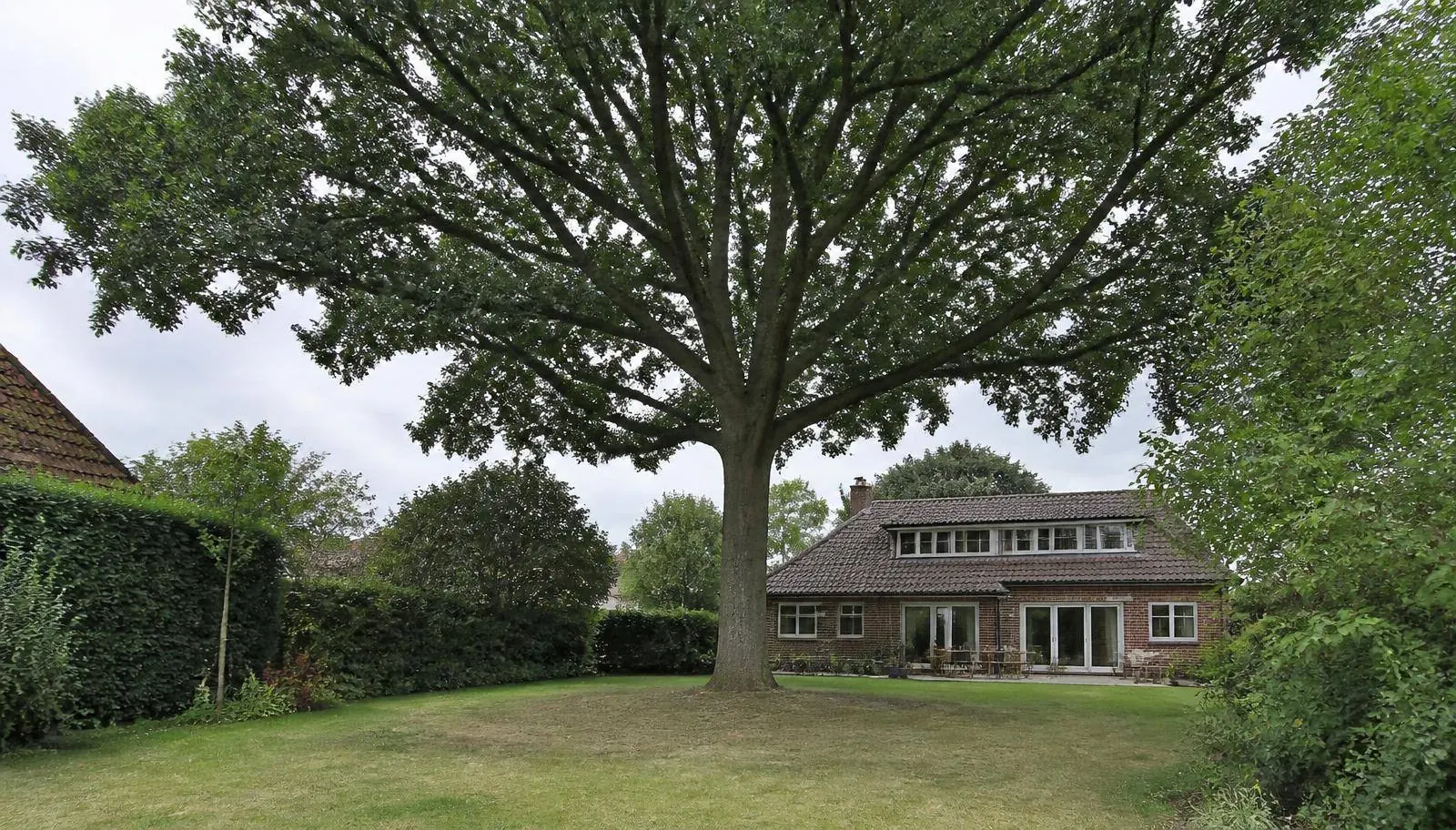
It is the job for a driveway where a delivery van keeps clipping the same branch, a lawn where the mower has to duck under limbs every cut, a garden path that catches everyone at head height, or a window that has gone dark because a lower limb has grown across it. It comes up constantly for homeowners around Oxted, Westerham and Caterham with mature oaks and limes close to the house, and for anyone putting up a shed, a trampoline or a car port under an existing tree.
It matters that it's done by someone who understands tree biology rather than someone with a ladder and a bow saw, because a bad crown raise is very hard to undo. Strip too many lower branches in one go and you shift the tree's weight and leaf area upward, which stresses the trunk and can trigger epicormic growth, a mass of weak, fast, badly attached shoots sprouting straight from the bark where the tree is trying to recover lost leaf area. Jack holds NPTC and City & Guilds certificates in tree climbing and aerial rescue and aerial cutting with free-fall techniques, and the work carries £10m employers' liability and £5m public and products liability.
Homeowners, landlords and builders needing clearance over drives, paths, lawns and windows across Surrey, Kent and Sussex.
Low branches blocking vehicle or pedestrian access, restricting light to a window or lawn, or in the way of new building work.
Selective removal of lower limbs back to the collar, arisings chipped and cleared, and a swept site before we leave.
If the tree carries a TPO or sits in a conservation area, we make the application to the council on your behalf.
What happens if it's left
A branch that sits at head height this year sits at exactly the same height next year, trees don't self-adjust their lower limbs to suit a driveway. Left alone, the same branch keeps thickening, the clearance keeps shrinking relative to whatever's parked or walking underneath it, and eventually something gives: a wing mirror, a roof gutter, or a person walking into it in the dark.
The other pressure is more structural. Low limbs on a mature tree are often the oldest and heaviest in the canopy, and if one has developed included bark at the union or a crack from years of flexing under vehicle strikes, it's a limb failure waiting for the wrong gust rather than a tidy pruning job. That risk sits directly over whatever's parked underneath it.
The mistakes we see most from DIY crown raising are all avoidable: cutting flush against the trunk instead of at the collar, which removes the tree's own healing tissue and leaves an open wound; taking too much canopy off in one visit, which shocks the tree into a flush of weak epicormic shoots; leaving jagged stubs that die back and rot inward; and topping side branches flat rather than pruning to a lateral, which is bad practice by any arboricultural standard and simply creates the same problem again in a few years.
A branch that clips a van roof or a gutter repeatedly eventually causes real damage, and the cost lands with whoever owns the tree.
Flush cuts and stubs don't seal properly. Decay gets into the stem faster than it would from a correct collar cut.
Take too much canopy at once and the tree responds with a mass of weak, badly attached shoots that need managing again within a couple of seasons.
Long-standing low limbs can carry included bark or old cracks that aren't obvious from the ground until the branch is loaded or moving in wind.
Cutting a TPO or conservation-area tree without consent is prosecutable, even for a modest pruning job that looks minor.
Cutting into an active nest between March and August is an offence, the canopy needs checking before work starts in that window.
What you get
Limbs are lifted to the height you actually need, over a drive, a path or a window, agreed before the climber goes up.
Every cut goes back to the collar or a lateral in line with recognised pruning practice, so the tree seals the wound rather than rotting from it.
Canopy taken off in proportion to keep the tree in balance, avoiding the stress response that triggers epicormic growth.
£10m employers' and £5m public and products liability cover, held by the crew doing the actual cutting.
Chipping and clearance are part of the job, not an extra line added once the branches are on your drive.
Windows, lawns and drives get their light and headroom back without the tree losing its overall shape or canopy.
Crown raising looks simple from the ground, but how much can be removed, and how, depends heavily on the tree's species, its age, and what it's growing over. Here is what actually changes the approach.
The branch collar is the slightly swollen ring of tissue where a branch joins the trunk or a larger limb. It contains the cells the tree uses to compartmentalise and seal a wound. A correct pruning cut sits just outside that collar, close enough to remove the whole branch, far enough out to leave the collar intact. Cut flush with the trunk and you remove that healing tissue along with the branch, leaving a wound that stays open far longer and lets decay travel into the stem.
The same principle applies lower down the branch: where a limb is being shortened rather than removed entirely, the cut goes back to a lateral branch or fork large enough to take over the role of a leader, never left as a bare stub. A stub can't callus over properly, dies back from the tip, and becomes a point of entry for decay fungi over the following seasons.
As a widely followed arboricultural rule of thumb, no more than around a quarter of the live crown should be removed in a single operation, and for a mature tree that's already under some stress, drought, root disturbance, recent construction nearby, even less is sensible. Crown raising specifically removes lower limbs, which on many species carry a meaningful share of total leaf area, so it's easy to over-prune a tree that looks fine from underneath but is losing more canopy than it can comfortably replace.
Where a client wants more clearance than can safely be taken in one go, the honest answer is to phase it, lift what's sensible this visit, let the tree respond over a season or two, and come back for the rest. It costs a second site visit rather than a second full job, and it protects the tree.
Oak and beech carry heavy, long-lived lower limbs that can be structurally significant to the tree's overall balance, so raising a mature oak or beech is done conservatively and with the whole crown considered, not just the branch in the way. Fast-growing species such as poplar, willow and leylandii respond to lifting with vigorous regrowth and may need a repeat visit sooner. Fruit trees and ornamentals such as cherry and magnolia are more sensitive to large wounds and are pruned with smaller cuts and closer attention to timing.
Evergreens including conifers and hollies hold their lower branches differently again, removing them can expose a bare, unattractive lower trunk that never re-foliates, so with these species we talk through the finished look before cutting rather than after.
Crown raising can be carried out at most times of year, but between March and August the canopy is checked for active nests before any cutting starts, disturbing a nesting bird is an offence under UK law regardless of how minor the pruning is. Outside that window, late autumn and winter are often the easiest time to work: no leaf cover means the crew can see branch structure and target clearance clearly, and there's less risk of the tree being in active leaf-flush when the cuts are made.
Some species are best avoided at certain times for their own health, birch and maple can 'bleed' sap heavily if cut in late winter or early spring, so those are usually scheduled for summer or early autumn instead. We factor species-specific timing into the quote rather than just working to a generic calendar.
A tree with a Tree Preservation Order, or one standing in a conservation area, needs the council's written consent before any pruning, including crown raising, which some homeowners assume is minor enough to skip the paperwork. It isn't; the requirement applies to any work that affects the tree's form or health, and we submit those applications for you across Tandridge, Sevenoaks, Reigate and the surrounding authorities.
Where the job is about clearing a driveway, a car port or scaffolding for building work, we plan the lift around the actual dimensions needed rather than a rough estimate, vehicle height, wing mirror width, or scaffold clearance, so the tree isn't over-pruned to solve a problem that needed a smaller cut.
Questions
Related work
A crown that has outgrown its plot does not need the top taken off, it needs its branch length reduced back to sound growth points, in proportion, so the tree keeps its natural shape and stays healthy while it does the job of clearing a roofline, a boundary or a view.
When a tree is fine everywhere except one side, pressing on a wall, tangled in an overhead line, or crowding a boundary fence, a full crown reduction is more than the problem needs.
Dead and hanging limbs don't announce themselves before they fail.
We cover Oxted, Westerham, Edenbridge, Sevenoaks, Biggin Hill, Bromley, Tunbridge Wells, Redhill and the surrounding villages, see the towns our tree surgeons cover across Surrey and Kent, browse all tree surgery services, read about Jack and the crew, or go straight to the free tree surgery quote form.
Free quote
Send the form or call and we will book a free site visit, usually within 7 days. You get an honest opinion on how much clearance can safely be taken in one visit, and an itemised written quote the same day as the visit, no obligation, no sales call afterwards.
Call 07375 701290Five Pebble Hill Cottages, Westerham Road, RH8 0EA · Mon–Sat 8am–9pm · Sunday closed