Secondary failure
A hung-up limb or split trunk rarely stays static, it can come down with no further warning at any time.
Emergency & storm damage
A tree down across a driveway, a limb through a roof or a trunk leaning further after every gust is not a job for the online form. Out-of-hours call-outs are available, phone 07375 701290 directly and we'll talk through what's happened and what needs to happen next, from making the site safe to full removal and the paperwork your insurer will want to see.
12 years handling storm and failure call-outs across the borders, £10m employers' and £5m public liability cover.
12 yrs
Experience assessing and clearing storm and failure damage
£15m
Total insurance cover, £10m employers', £5m public and products
NPTC
City & Guilds certificates in felling, climbing and aerial rescue
Out-of-hours
Call-outs available, phone rather than use the form
The service
Emergency tree work covers anything where a tree or a large part of one has already failed, or is actively failing, and is putting a building, a road, a boundary or a person at risk. That includes a whole tree blown over in wind, a major limb that has torn out and is hanging or has fallen, a trunk that has split or is visibly leaning further than it was, and storm-snapped tops left hanging in the canopy above a garden or driveway. In every one of those situations the priority is making the site safe first and working out the full picture second.
It is for homeowners who wake up to a tree across the garden or the drive after a night of wind, for anyone whose tree has come down on or near a neighbour's property, for landlords and managing agents with storm damage on a let property, and for anyone who has had a limb come down on a car, a shed, a fence or a roof. Out-of-hours call-outs are available for exactly this reason, storm damage doesn't wait for office hours, and neither does the risk it creates.
The first job on arrival is almost always assessment and making safe: establishing whether anything is still moving, cordoning off the danger area, and removing whatever is actively unstable before anything else is touched. From there the work moves to controlled sectional removal of the failed material, and, where the rest of the tree is still standing, a proper look at whether the remaining stem is safe to leave, needs reducing, or needs taking down as well. Jack holds NPTC and City & Guilds certificates covering felling up to 380mm, tree climbing and aerial rescue, and aerial cutting with free-fall techniques, and the work is covered by £10m employers' liability and £5m public and products liability, cover that matters most on exactly this kind of unpredictable job.
Homeowners, landlords and managing agents with a tree down, a hanging limb, or storm damage to a garden, drive or boundary.
A tree has come down, a limb is hanging or has fallen, a trunk has split, or a tree is leaning further after wind. Phone rather than use the form.
Making the site safe, controlled removal of the failed material, arisings chipped and cleared, and an assessment of what remains standing.
Photos, notes and an itemised invoice you can pass to your insurer or loss adjuster where the damage is being claimed for.
What happens if it's left
A hanging limb rarely stays exactly where it is. Wind, its own weight, and the torn fibres holding it in place all work against it staying put, and a limb that looks stable in the morning can come down on its own by the afternoon, often with less warning than the storm that caused it in the first place. A split trunk is the same problem on a larger scale: the crack widens with every gust, and by the time it fails completely there is far less control over which direction it goes.
The financial side moves the same way. A tree that has already fallen onto a car, a fence, a shed or a roof turns a tree problem into a buildings, contents and possibly a third-party claim all at once, and the longer a dangerous hang-up or a leaning trunk is left, the more likely it is to cause a second incident before anyone gets to deal with the first. Acting quickly is not about panic, it's about stopping one failure becoming two.
The mistakes we see most in the aftermath of a storm are people going into the garden themselves to 'just clear the small stuff' near a tree that is still under tension, propping or roping a leaning trunk as a temporary fix that gives false confidence, and waiting to call anyone until the insurer has been notified and a loss adjuster has visited, which can leave a genuinely dangerous hang-up in place for days longer than it needs to be.
A hung-up limb or split trunk rarely stays static, it can come down with no further warning at any time.
A second limb or the rest of a leaning tree failing onto the same building multiplies the claim and the disruption.
A tree across a driveway or the only route to a property stops normal life until it's cleared.
Wood under tension after a storm behaves unpredictably, cutting into it without the right technique is genuinely dangerous.
Moving or cutting damage before it's documented can complicate a claim; we can supply photos and an itemised invoice.
A tree leaning towards a boundary, pavement or road extends the liability beyond your own property.
What you get
No web form in the way when it's urgent, call 07375 701290 and speak to someone who can act on it.
The immediate danger is dealt with before anything else, rather than working straight into a jumbled removal.
NPTC and City & Guilds certified climbing, aerial rescue and cross-cutting for wood under tension or shock-loaded.
£10m employers' and £5m public and products liability cover the exact scenario emergency work presents.
Photos and an itemised invoice you can hand straight to an insurer or loss adjuster.
The rest of the tree gets checked too, so you're not calling again next month for the part that was missed.
Emergency call-outs are not simply planned tree work done in a hurry, the wood is behaving differently, the risk assessment happens on the spot, and the priorities are in a different order. Here's what actually changes.
The first thing that happens at any storm or failure call-out is a walk-round assessment before a saw comes out at all: what has actually failed, what is still attached and under tension, what direction anything still moving is likely to go, and what's underneath or nearby that needs protecting or evacuating first. This is different from a planned removal, where the tree has already been surveyed calmly in advance.
Cordoning off the area, keeping people, pets and vehicles away from anything still capable of moving, often happens before any cutting starts, particularly where children or through-traffic on a drive or path are involved. It's a step that can feel like it's wasting time when everyone wants the mess gone, but it's the step that prevents a second incident.
A limb that has torn partway and is hanging by splintered fibres is under a completely different set of forces to a healthy branch being cut in a planned reduction. It can be under tension, under compression, or twisted, and cutting into the wrong point can release that energy suddenly and violently. This is exactly the kind of situation NPTC aerial rescue and cross-cutting training is built around, and it's why storm call-outs are not a job for a general contractor with a chainsaw.
A split or partially failed trunk carries the same risk at a larger scale, the crack can be hiding a failure that runs much further into the stem than is visible from the ground, which changes how, and from where, it's safe to approach the cut.
Storm damage doesn't respect convenient access. A hung-up limb over a conservatory, a split stem leaning across a boundary fence, or wind-thrown wreckage blocking the only driveway all call for whatever combination of climbing, rigging and lowering lines gets the job done safely for that specific tangle of wood, there usually isn't a single standard method.
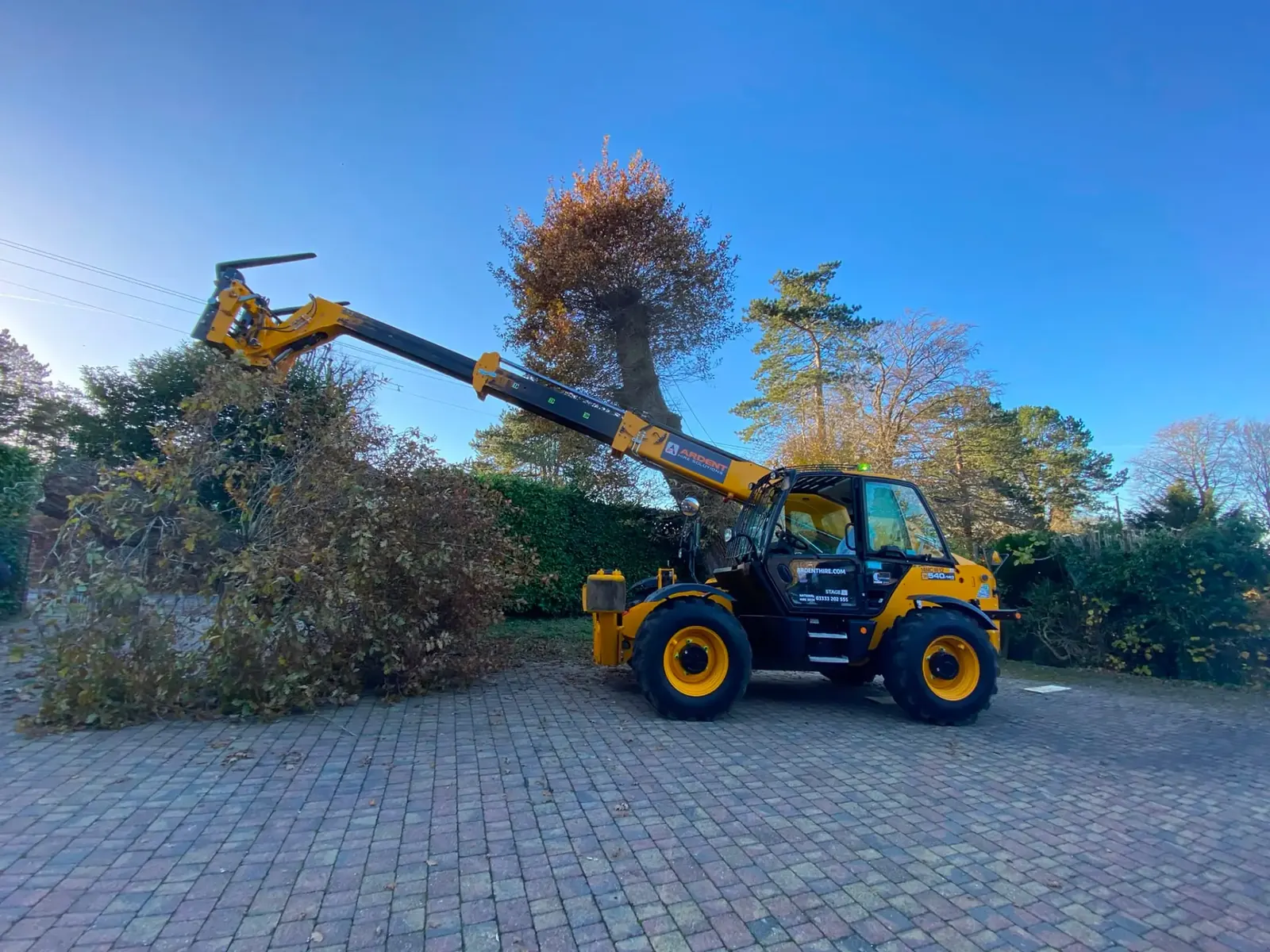
Where a tree is too compromised structurally to climb safely, or where ground conditions or obstacles rule out a safe climb, a mobile elevating work platform (MEWP) is used instead, giving the crew a stable working position without putting weight on wood that can't be trusted.
A storm rarely damages a tree in isolation from the rest of it. Once the immediate hazard is down, the standing remainder gets a proper look, root plate movement at the base can indicate a tree is now unstable even if it's still upright, a snapped leader can leave the remaining crown unbalanced, and torn bark at a union can be an entry point for decay for years afterwards.
Depending on what's found, the honest recommendation might be to leave it, to reduce it to take weight and windage off a weakened structure, or to remove it entirely rather than have you facing the same call-out again in the next storm.
Where the damage is being claimed for, a fence, a shed, a car, a roof, or the tree itself, photographs taken on arrival and before work starts, along with an itemised invoice describing exactly what was done, give you something concrete to hand to an insurer or a loss adjuster. It doesn't replace your own claim process, but it removes any ambiguity about what state things were in and what was required to make them safe.
If a neighbouring tree has caused damage to your property, or vice versa, the same documentation is useful for establishing what happened without a dispute over recollection weeks later. We'll always tell you plainly what we're seeing rather than guessing at fault.
Questions
Related work
A tree that has split, is partially uprooted, or is leaning further than it should is not a job to approach without a proper plan.
A tree that has outgrown its garden, died back, or started leaning over a roof does not get cheaper or safer to deal with.
Dead and hanging limbs don't announce themselves before they fail.
We cover Oxted, Westerham, Edenbridge, Sevenoaks, Biggin Hill, Bromley, Tunbridge Wells, Redhill and the surrounding villages, see the towns our tree surgeons cover across Surrey and Kent, browse all tree surgery services, read about Jack and the crew, or go straight to the free tree surgery quote form.
Free quote
Call 07375 701290 rather than using the form, out-of-hours call-outs are available for fallen or failing trees. We'll make the site safe, clear the damage, and give you documentation for any insurance claim.
Call 07375 701290Five Pebble Hill Cottages, Westerham Road, RH8 0EA · Mon–Sat 8am–9pm · Sunday closed