Hidden internal decay
Wood can look sound from outside while being extensively decayed within, changing how much weight it can actually bear.
Dangerous & wind-blown trees
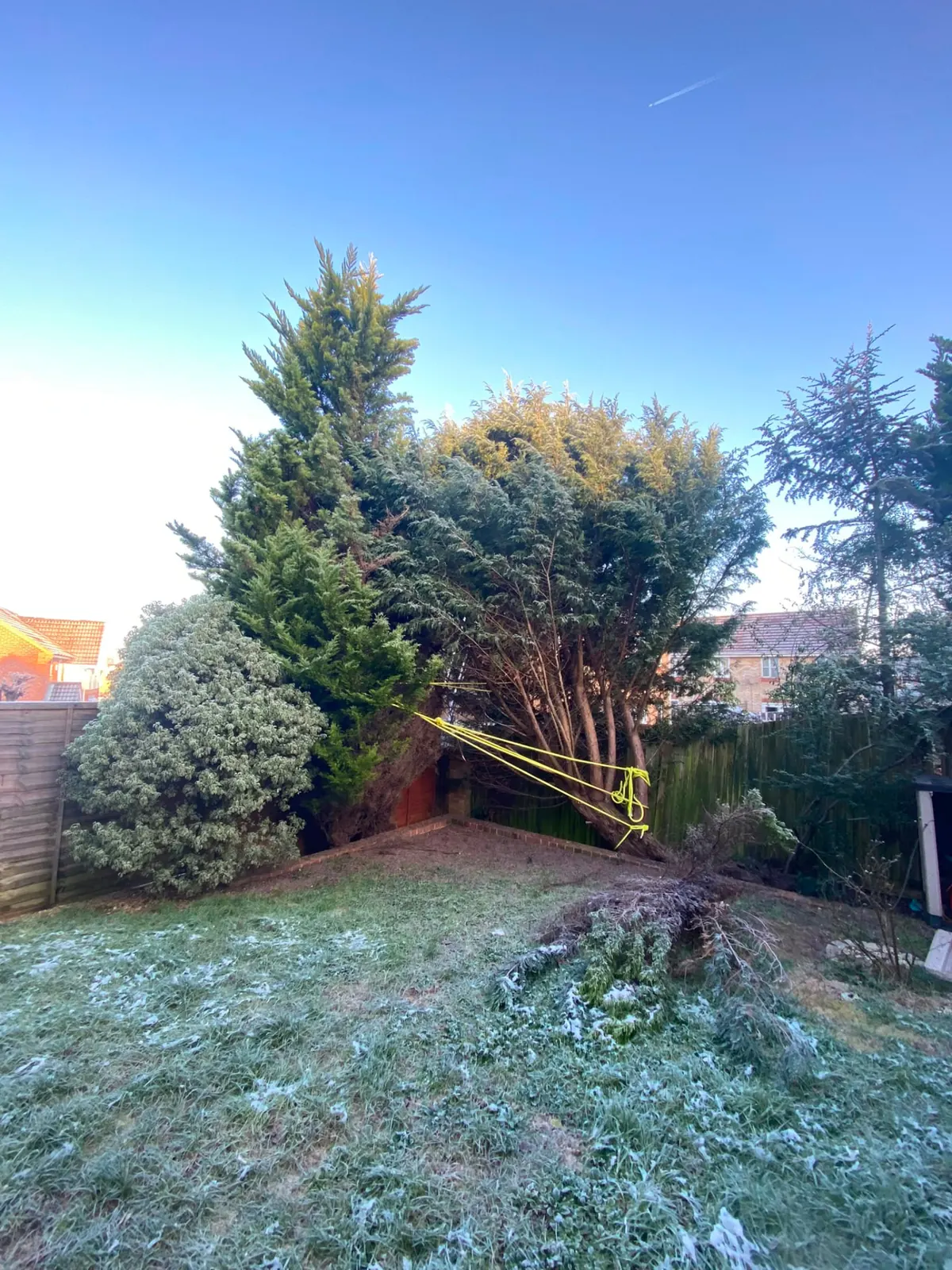
A tree that has split, is partially uprooted, or is leaning further than it should is not a job to approach without a proper plan. We assess the structure, work out whether it can be climbed or needs a MEWP or winch, and dismantle it in a sequence that keeps the load under control from the first cut to the last.
12 years assessing and taking down structurally compromised trees, £10m employers' and £5m public liability cover.
12 yrs
Experience with structurally compromised and wind-blown trees
£15m
Total insurance cover, £10m employers', £5m public and products
NPTC
City & Guilds certificates in felling, climbing and aerial rescue
7 days
Typical wait for a free site visit, written quote sent same day
The service
A dangerous tree is one where the normal structure that keeps a tree standing and predictable has been compromised, a split trunk or major union, a root plate that has lifted or partially failed, a significant lean that has developed or worsened, or extensive decay found at the base or through the stem. These are trees where a standard felling or climbing approach may not be safe, because the wood itself can no longer be trusted to behave the way healthy wood would.
It's needed by homeowners with a tree that has moved visibly after wind or heavy rain, by anyone who's noticed a widening crack or lifted turf around the base of a large tree, by neighbours dealing with a tree on an adjoining property that looks unstable, and by landowners and estates around Tunbridge Wells and Sevenoaks with mature trees showing signs of root plate movement after storms. The common thread is that something about the tree looks different to how it looked last month, and that difference usually means the safety margin has narrowed.
The job starts with assessment, not cutting: working out what's actually holding the tree up, what's failed already, and what load is on which part of the structure. From there the crew decides between climbing with reduced section sizes, dismantling from a mobile elevating work platform (MEWP) where the wood can't be trusted to bear a climber's weight, or using a winch to control the direction of fall on a tree that's already leaning or partially rooted out. Jack holds NPTC and City & Guilds certificates in felling up to 380mm, tree climbing and aerial rescue, and aerial cutting with free-fall techniques, and the work is covered by £10m employers' liability and £5m public and products liability.
Homeowners, neighbours and estates with a tree that has split, lifted at the root plate, developed a lean, or shown significant decay.
After a storm, following visible movement at the base, on a tree with a widening crack, or wherever a structural assessment flags real risk.
Structural assessment, dismantling by climbing, MEWP or winched felling as the tree requires, arisings chipped and cleared.
TPO and conservation-area applications submitted on your behalf where the tree is protected.
What happens if it's left
The difficult thing about a structurally compromised tree is that the visible signs, a crack, a lean, lifted turf at the base, often understate how far the failure has actually progressed inside the stem or below ground. Wood that looks intact from the outside can be extensively decayed within, and a root plate that has lifted a few centimetres on one side can already be carrying a fraction of the anchorage it had before. The tree can look largely the same for weeks and then fail completely in the next spell of wind.
Wind-blown and partially uprooted trees carry a particular risk because the root plate itself becomes an unpredictable, heavy, hinged mass, it can settle back down under load, shift further, or lift again as the tree is worked on, which is exactly why these are not felled using a standard direction-and-hinge cut. Getting the sequence wrong on a partially rooted tree risks the whole root plate moving unpredictably while someone is still working near or under it.
The mistakes we get called out to correct are almost always the result of underestimating how compromised the tree actually is: someone climbing a stem with an unseen internal crack, a domestic contractor felling a leaning tree in the direction it's already leaning without controlling the fall, or a homeowner deciding to 'wait and see' on a lifted root plate through another storm because the tree hasn't fallen yet.
Wood can look sound from outside while being extensively decayed within, changing how much weight it can actually bear.
A partially uprooted tree's root plate can shift further at any point, including while work is underway.
A leaning or split tree felled without a winch or rigging plan can go further than expected in the direction of the lean.
Every additional spell of wind loads an already-compromised structure again, narrowing the safety margin further.
Climbing a tree with a hidden structural fault carries a real risk that standard tree work training is designed to identify and avoid.
A tree leaning towards a house, road or boundary widens who and what is at risk if it fails uncontrolled.
What you get
Structure is properly read before any decision is made on climbing, MEWP or winching, not assumed.
Reduced section sizes, aerial platforms or winched felling used specifically where the wood can't be trusted normally.
Partially uprooted trees are worked with the root plate's unpredictable movement accounted for, not ignored.
NPTC and City & Guilds certificates in felling, climbing and aerial rescue, held by the crew doing the cutting.
£10m employers' and £5m public and products liability cover, relevant precisely because these are less predictable jobs.
Arisings chipped and the ground checked, so the hazard is fully resolved rather than partially tidied.
Dangerous tree work is defined by the method changing to fit the specific failure, a split stem, a lifted root plate and advanced basal decay each call for a different approach. Here's how those decisions actually get made.
The assessment covers the whole tree, not just the obvious damage: checking the extent of a crack by sound and by eye, looking at fungal brackets or cavities at the base as evidence of internal decay, checking how far a root plate has lifted and on which side, and assessing whether a lean has developed recently or has been stable for years. This determines everything that follows.
Where the internal condition can't be confirmed from the ground, the working assumption defaults to the more cautious method, smaller sections, more support, or a platform instead of a climb, because a wrong guess on a compromised tree has far higher consequences than on a healthy one.
Where a stem is sound enough to bear a climber's weight but individual limbs or the upper crown are suspect, the approach is usually still a climb, but with smaller section sizes and more conservative rigging than a standard removal, reducing the load on any single point of doubtful wood at any moment.
Where the stem itself can't be trusted to bear a climber safely, extensive base decay, a major crack running into the main stem, or a split that's already partway through, a mobile elevating work platform (MEWP) is used instead, keeping the crew's full weight off the tree entirely while the dismantling happens from a stable external platform.
A tree that is leaning, partially uprooted, or split at the base but still needs to come down as a fell rather than a piece-by-piece dismantle is handled with a winch line attached before any cut is made. The winch lets the crew control and correct the direction of fall independently of which way the tree is naturally leaning, rather than relying on a hinge cut alone to do that job.
This is standard practice on wind-blown trees where the root plate is already partially lifted, the winch also helps manage how much further the root plate moves as the tree comes down, rather than letting it lift and shift unpredictably under the changing load.
A partially uprooted tree presents a hazard that's easy to underestimate: the root plate itself, often a metre or more across and heavy with soil, can move further at any point while the stem above it is worked on, and it doesn't behave predictably once weight is removed from the crown. The working plan accounts for this from the outset, including where crew can and can't stand relative to the root plate while cutting.
Once the stem is down, the root plate is assessed on its own, sometimes it needs to be pulled fully clear and made safe or removed as part of the job, particularly where it sits near a path, drive or boundary and could still present a hazard even after the tree itself is gone.
Where a dangerous or wind-blown tree carries a Tree Preservation Order or sits in a conservation area, dead, dying or dangerous exemptions can apply, but they're narrower than people assume and the local authority still generally needs to be notified. We handle that notification and any application on your behalf across Tunbridge Wells, Sevenoaks and the surrounding authorities.
After the tree is down, the ground where the root plate lifted is often left disturbed, and that area can need reinstating, backfilling, levelling or reseeding, depending on what's planned for the space afterwards. We'll flag what we see and what your options are before we leave rather than leaving you to notice it later.
Questions
Related work
A tree down across a driveway, a limb through a roof or a trunk leaning further after every gust is not a job for the online form.
A tree that has outgrown its garden, died back, or started leaning over a roof does not get cheaper or safer to deal with.
Before you decide whether a tree needs reducing, removing or leaving alone, you need an honest look at its actual condition, not a guess from the pavement.
We cover Oxted, Westerham, Edenbridge, Sevenoaks, Biggin Hill, Bromley, Tunbridge Wells, Redhill and the surrounding villages, see the towns our tree surgeons cover across Surrey and Kent, browse all tree surgery services, read about Jack and the crew, or go straight to the free tree surgery quote form.
Free quote
Send the form or call 07375 701290 and we'll book a free site visit, usually within 7 days, to properly assess a split, leaning or wind-blown tree, with a written itemised quote sent the same day.
Call 07375 701290Five Pebble Hill Cottages, Westerham Road, RH8 0EA · Mon–Sat 8am–9pm · Sunday closed