Sudden, unpredictable failure
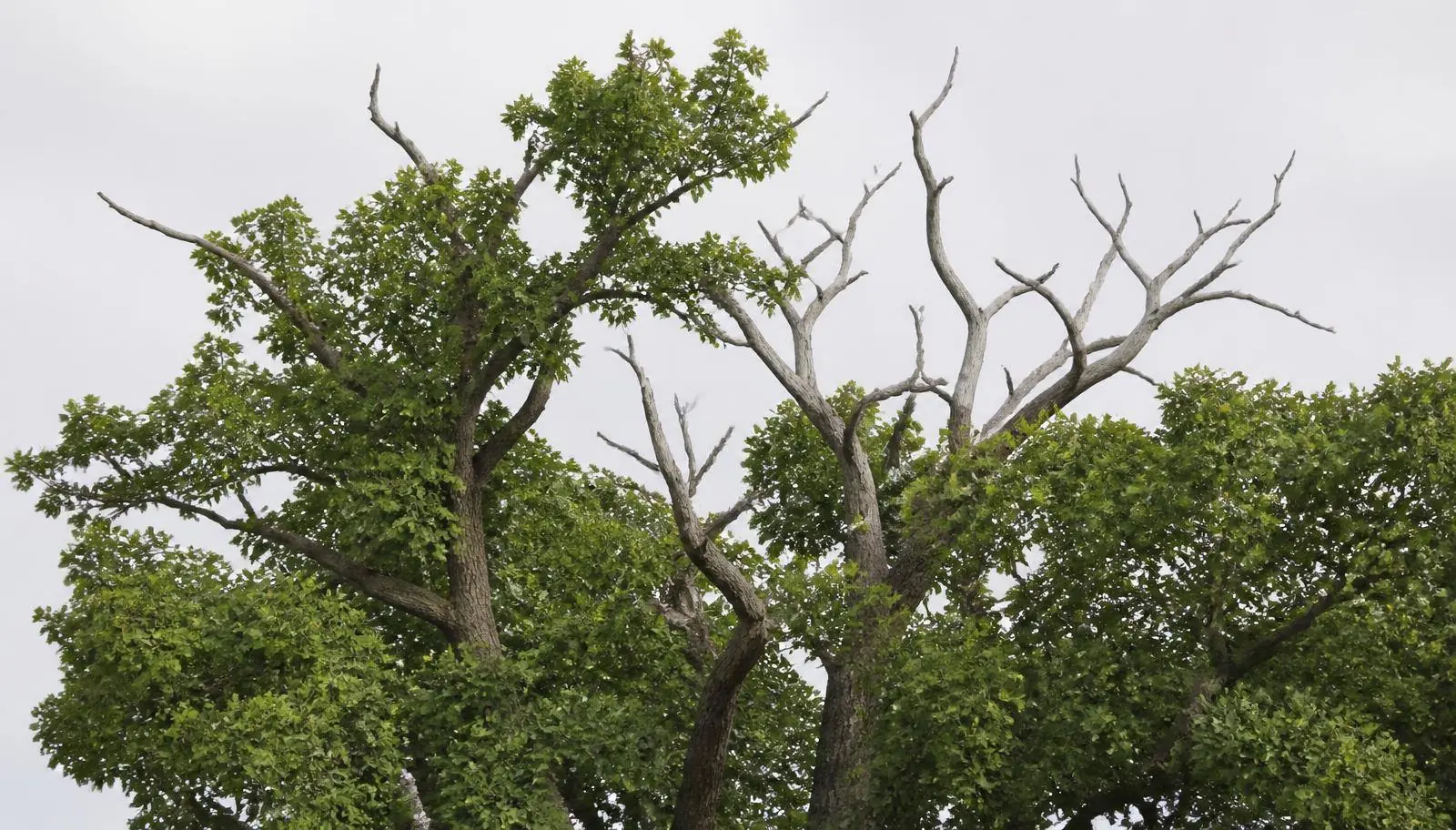
Dead branches can shear off with no warning signs, on calm days as well as windy ones, because the wood has already lost its flexibility.
Dead-wooding
Dead and hanging limbs don't announce themselves before they fail. Dead-wooding removes them at the source, cut back to sound wood at the branch collar, target-pruned so the cut heals correctly, before a dry branch drops on a path, a car, or someone standing underneath it.
12 years in the canopy, 59+ five-star Google reviews, £10m employers' and £5m public liability cover.
12 yrs
Hands-on climbing and dead-wood removal across the borders
£15m
Total insurance cover, £10m employers', £5m public and products
NPTC
City & Guilds certificates in climbing, aerial rescue and aerial cutting
7 days
Typical wait for a free site visit, with the written quote the same day
The service
Dead-wooding is the selective removal of dead, dying, diseased or hanging branches from a living tree, leaving the healthy canopy untouched. Every cut is target pruning: made at the branch collar, back into sound wood, so the tree can compartmentalise the wound rather than being left with a stub that continues to die back. It isn't a reshape or a reduction, it's removing wood that has already stopped functioning and has become a falling hazard rather than a living part of the tree.
It's the job for a mature oak or beech overhanging a driveway, garden or play area where dead limbs have built up in the upper canopy over several dry summers; for trees near a car park, a footpath or a boundary fence where a falling branch has somewhere specific to land; and for anyone who's had a tree survey flag deadwood as a defect needing action. It comes up regularly on the older trees around Oxted, Godstone and Lingfield, where large specimens have accumulated genuine deadwood loads that were fine ten years ago and aren't now.
Deadwood is unpredictable in a way live wood isn't, it dries out, loses flexibility, and can shear off in a moderate gust with no visible warning beforehand, unlike a live branch that usually shows stress signs first. Removing it safely from height means working on rope and harness through a canopy that may have several more dead limbs above the one being cut. Jack holds NPTC and City & Guilds certificates in tree climbing and aerial rescue and aerial cutting with free-fall techniques, and the work carries £10m employers' liability and £5m public and products liability.
Homeowners, landlords, schools and site managers with mature trees over paths, drives, play areas or parking across Surrey and Kent.
Visible dead or hanging limbs, a tree survey flagging deadwood as a defect, or a tree overhanging somewhere people or vehicles regularly stop.
Target pruning of dead, dying and hanging wood back to the collar, arisings chipped and cleared, and a swept site before we leave.
If the tree carries a TPO or sits in a conservation area, we make the application to the council on your behalf.
What happens if it's left
A live branch under stress usually shows something first, leaves wilting, bark splitting, a slow lean developing over a season. Deadwood has already finished doing any of that. Once a branch has died it dries out, loses its flexibility, and becomes a rigid, brittle piece of timber sitting in a moving canopy, held on by wood fibres that are getting weaker every month rather than stronger.
That's why deadwood failure is one of the most common causes of tree-related injury and property damage that isn't linked to a whole-tree collapse, it happens on trees that otherwise look perfectly healthy, on ordinary days rather than in named storms, because it only takes a moderate gust or the branch's own weight to finish the job. A large dead limb in the upper canopy of a mature oak or beech can weigh a substantial amount, and it has the whole height of the tree to fall through before it lands.
The mistakes we see most with deadwood are leaving it because 'the tree still looks fine' overall, having a landscaper or handyman remove it with a pole saw from the ground rather than climbing to inspect the whole canopy, and cutting flush rather than to the collar, which just creates a fresh site for decay to start again a few feet further down the same limb.
Dead branches can shear off with no warning signs, on calm days as well as windy ones, because the wood has already lost its flexibility.
A falling limb over a drive, path or parking area has a direct target underneath it far more often than people assume.
Ground-based pruning with a pole saw only reaches what's visible from below. Deadwood higher in the crown often goes unnoticed until it falls.
Landlords, schools and site managers with a documented deadwood risk that isn't acted on carry a real liability if it later fails.
Flush cuts remove the tree's own healing tissue at the collar and leave the fresh wound more exposed to decay than a correct cut would.
Cutting a TPO or conservation-area tree without consent is prosecutable, even where the work is limited to removing dead wood.
What you get
Dead and hanging limbs are taken out before they fail on their own terms, rather than after they've already landed somewhere.
Climbing through the crown finds deadwood that's invisible from the ground, not just the obvious branch that prompted the call.
Target pruning back to the branch collar means the tree seals the wound properly instead of dying back further from a stub.
Only dead, dying or hanging wood comes out, the tree's shape and healthy growth are left alone.
£10m employers' and £5m public and products liability cover, held by the crew doing the actual climbing and cutting.
Chipping and clearance are part of the job, not an extra line added once the deadwood is on the ground.
Dead-wooding is often treated as a minor job because nothing about the tree's shape changes, but it's frequently the most safety-critical work carried out in a canopy. Here is what actually shapes the approach.
Every dead-wooding cut is made back into sound, living wood at the branch collar, the slightly swollen ring of tissue at the base of a branch that contains the cells the tree uses to seal a wound. Cutting into that collar, or leaving a stub beyond it, stops the tree compartmentalising the cut properly and gives decay a route further into the limb or the trunk. Where a dead branch has already died back from a live union, the cut is made at the boundary between dead and live wood, not further along the dead section, so the healing tissue is preserved.
This is why dead-wooding is a climbing job rather than a ground-based one on anything but the smallest trees. Identifying exactly where a branch is genuinely dead versus simply dormant, and finding the correct collar to cut back to, needs someone in the canopy assessing bark, buds and wood colour at close range, not guessing from thirty feet below with a pole saw.
Not all deadwood carries the same risk. A dead limb still solidly attached at a strong union, high in a canopy with no target underneath, is a lower priority than a hanging branch caught in the crown below it, sometimes called a 'widowmaker', which can already be partially detached and needs almost no additional force to come free. Hung-up branches from a previous storm or a prior pruning job get flagged and removed first regardless of size.
Deadwood directly over a driveway, footpath, patio, play area or parking space is treated as a higher priority than the same deadwood over an unused corner of a garden, purely because of what's underneath it. We talk through priority with you at the quote stage rather than pricing every piece of deadwood as equally urgent.
Oak and beech are the species we most often dead-wood in this area, both are long-lived, both naturally shed lower and inner branches as the canopy matures and self-shades, and both can carry a genuine deadwood load after a run of dry summers, which puts extra stress on a tree's ability to support its full crown. Horse chestnut and ash can develop deadwood linked to disease, ash dieback in particular makes affected wood brittle and unpredictable, and a badly affected ash may need dismantling rather than selective dead-wooding.
Fruit trees and smaller ornamentals tend to carry proportionally less standing deadwood but can develop dead spurs and dieback after a hard prune or a wet season, which is picked up and removed as part of a wider pruning visit rather than treated as a separate dead-wooding job.
Deadwood is easiest to identify against a bare canopy in winter, when live branches have dropped their leaves and dead ones stand out clearly by their bark texture and lack of buds. Summer dead-wooding is still carried out where the hazard is live and can't wait, but between March and August the canopy is checked for active nests before cutting starts, as disturbing a nesting bird is an offence regardless of the reason for the work.
Storm damage and drought stress both tend to increase deadwood loads, so a tree that's had a hard, dry summer or come through strong winds is worth a look even without an obvious branch already down, the deadwood created by that stress is often only found once someone's up in the canopy.
A tree with a Tree Preservation Order, or one standing in a conservation area, needs the council's written consent before dead-wooding, in the same way as any other pruning work. Genuinely dead branches on an otherwise living tree usually fall within normal permitted work, but we confirm and apply where needed rather than assuming, and we handle the applications across Tandridge, Sevenoaks, Reigate and the surrounding authorities.
For landlords, schools, care homes and site managers with a documented duty of care, we can provide a written record of the deadwood removed and the date of the work, useful for your own risk register or insurer if a tree has previously been flagged in a survey.
Questions
Related work
A dense canopy blocking light or catching wind like a sail does not need a smaller shape, it needs less density.
Before you decide whether a tree needs reducing, removing or leaving alone, you need an honest look at its actual condition, not a guess from the pavement.
A tree that has split, is partially uprooted, or is leaning further than it should is not a job to approach without a proper plan.
We cover Oxted, Westerham, Edenbridge, Sevenoaks, Biggin Hill, Bromley, Tunbridge Wells, Redhill and the surrounding villages, see the towns our tree surgeons cover across Surrey and Kent, browse all tree surgery services, read about Jack and the crew, or go straight to the free tree surgery quote form.
Free quote
Send the form or call and we will book a free site visit, usually within 7 days. You get an honest assessment of the deadwood in your tree's canopy, and an itemised written quote the same day as the visit, no obligation, no sales call afterwards.
Call 07375 701290Five Pebble Hill Cottages, Westerham Road, RH8 0EA · Mon–Sat 8am–9pm · Sunday closed