Internal decay
Crossing and rubbing branches wound each other at the contact point, giving fungal decay a permanent entry route.
Crown thinning
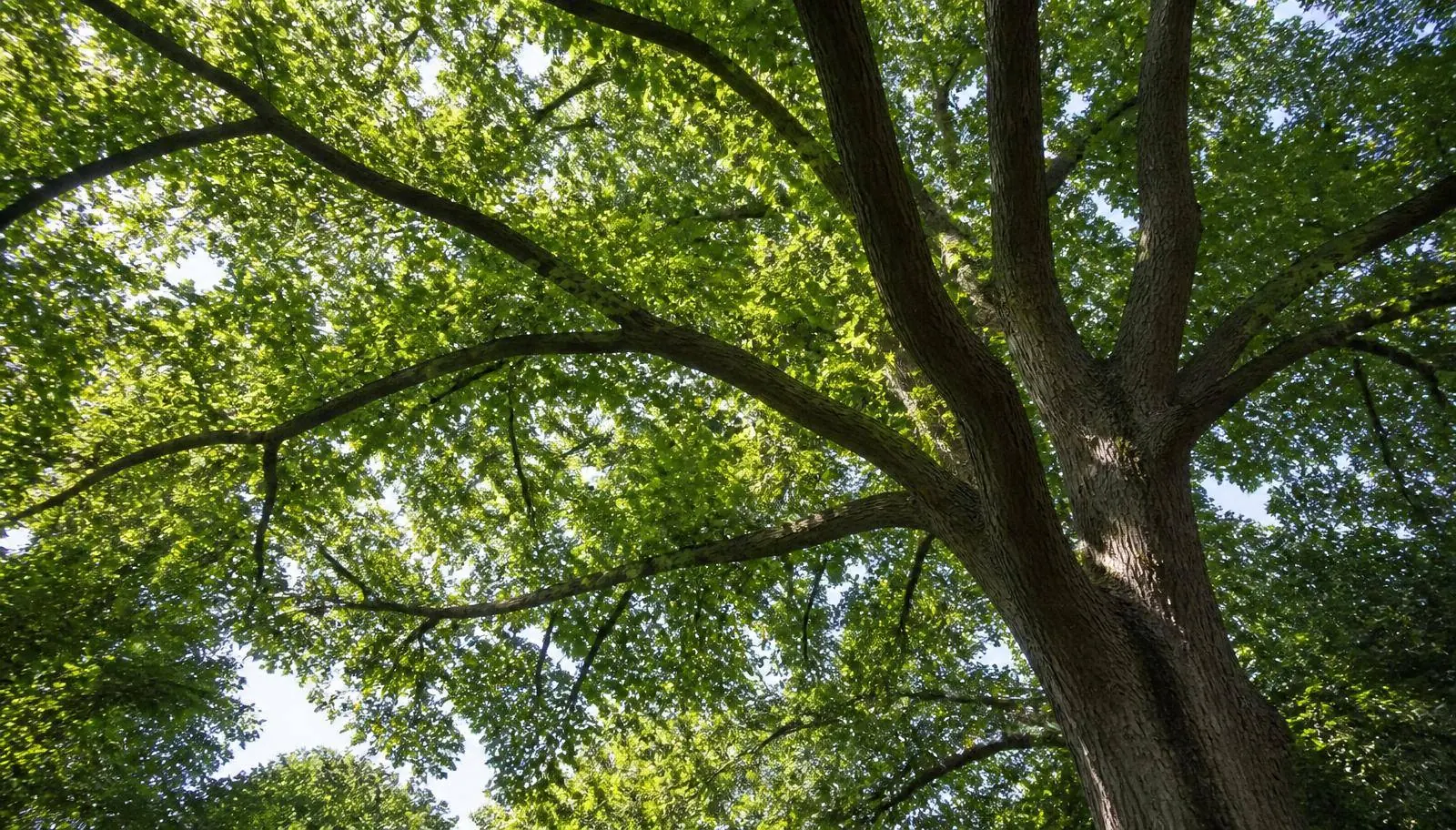
A dense canopy blocking light or catching wind like a sail does not need a smaller shape, it needs less density. Crown thinning removes a proportion of secondary branches evenly through the crown, letting light and air through without changing the tree's overall size or outline.
12 years thinning canopies across Surrey and Kent, 59+ five-star Google reviews.
12 yrs
Hands-on canopy management and thinning experience across the borders
£15m
Total insurance cover, £10m employers', £5m public and products
NPTC
City & Guilds certificates in climbing, aerial rescue and aerial cutting
7 days
Typical wait for a free site visit, with the written quote the same day
The service
Crown thinning is the selective removal of a proportion of secondary and tertiary branches, the smaller, inner growth rather than the main scaffold limbs, spread evenly through the whole crown. The tree keeps the same overall size, height and outline; what changes is how much light and air can pass through it. Typical thinning removes somewhere between 10% and 30% of the crown's density, depending on the species and how congested the canopy has become, and it is never taken from one side or one section, since that would unbalance the tree rather than open it up.
It is used where a dense canopy is casting heavier shade than a garden or lawn beneath it can tolerate, where a large tree is acting like a sail in wind and putting more load through the root plate and stem than it needs to, or where crowded, crossing and rubbing branches inside the crown are creating wound sites and poor airflow that encourage fungal problems. It is common on mature broadleaves in gardens across Redhill, Reigate and Caterham where a tree planted decades ago has simply filled out.
Thinning correctly means knowing which branches to take and which to leave, because removing the wrong ones, cutting only what is easy to reach rather than what is actually crowding the crown, leaves an uneven, patchy canopy that looks worse than when you started and does nothing for wind loading. Jack holds NPTC and City & Guilds certificates in climbing, aerial rescue and aerial cutting, and prunes to recognised arboricultural good practice on every job. The work is covered by £10m employers' liability and £5m public and products liability.
Homeowners with a dense, heavily shading canopy, and anyone concerned about wind loading on a large mature tree.
A congested crown blocking light, crossing and rubbing branches inside the canopy, or excessive wind resistance on a large tree.
Even, whole-crown thinning to a proportion agreed at quote stage, arisings chipped and cleared, and a tidy finish.
TPO or conservation-area applications are submitted on your behalf where the tree is protected.
What happens if it's left
A dense, unthinned canopy does not just block light from the lawn, it works against the tree itself. Branches crossing and rubbing inside the crown wear through bark at the contact point, creating an open wound that never fully closes and gives decay fungi a permanent entry point. Poor airflow through a congested canopy also keeps foliage damp for longer after rain, which is exactly the condition that fungal leaf and branch diseases favour.
The wind-loading problem is less visible but arguably more serious. A dense crown catches far more wind than a well-managed one, and that load is transferred straight down through the stem to the root plate. On a large, mature tree with a compromised root system, from nearby construction, soil compaction or root disease, that extra load in a storm is sometimes the difference between the tree standing and the tree coming down.
The mistake we see most often is a thin carried out unevenly: branches removed from whatever is easiest to reach from the ground or from one side of the crown, rather than assessed evenly across the whole tree. That leaves a lopsided canopy, does little for overall wind resistance, and often has to be corrected properly at extra cost once the imbalance becomes obvious a season later.
Crossing and rubbing branches wound each other at the contact point, giving fungal decay a permanent entry route.
Poor airflow through a dense crown keeps foliage damp longer after rain, favouring fungal leaf and branch diseases.
A dense canopy transfers more load to the stem and root plate in a storm than a properly thinned one.
Removing branches from whatever is easiest to reach, rather than evenly, leaves a lopsided crown that needs correcting later.
High wind load on a tree with a compromised root system raises the real risk of the whole tree failing, not just a limb.
Thinning a TPO or conservation-area tree without consent is prosecutable, whatever the intention behind the work.
What you get
The tree keeps its size and outline, but noticeably more light reaches the lawn or beds underneath.
Less sail area through the crown means less force transferred to the stem and root plate in a storm.
Removing crossing and rubbing branches stops them wounding each other at the contact point.
Improved air movement through the crown reduces the damp conditions fungal diseases favour.
Density is reduced evenly across the whole crown, so there is no lopsided or patchy look afterwards.
Work carried out to recognised arboricultural good practice, under £10m employers' and £5m public liability cover, with TPO paperwork handled for you.
Thinning is judged branch by branch through the whole crown, not applied as a blanket cut. Here is how the percentage, the selection and the access are actually worked out.
A thin is specified as a percentage of the crown's density to be removed, typically in the 10% to 30% range, agreed at the site visit based on how congested the canopy is and what the thin needs to achieve. A tree being thinned purely to let more light through a lawn might need less removed than one being thinned specifically to reduce wind sail on a large, exposed specimen.
The figure is a guide for even distribution, not a target hit by cutting a fixed number of branches from one area. The climber works methodically through the whole crown, inner, outer, upper and lower, removing selected secondary and tertiary branches so the reduction in density reads the same from every angle once finished.
Selection follows a clear order of priority: dead, dying, diseased and damaged wood first, then crossing and rubbing branches that are wounding each other, then weakly attached or poorly positioned secondary growth, and finally, if further thinning is still needed to hit the agreed percentage, healthy secondary branches chosen for even spacing rather than convenience of access.
Main scaffold limbs, the primary structural branches that give the tree its shape, are not removed in a thin; touching those would be a reduction or a different operation altogether. Thinning stays confined to the smaller growth that adds density without adding structural shape, which is exactly why the tree looks the same size afterwards.
Thinning a large, mature crown properly means the climber has to move through the whole tree, not just work from one or two anchor points, because uneven access is how uneven thinning happens. In bigger specimens across Redhill and Reigate this can mean a longer day than the equivalent-sized reduction, since the work is spread thin and wide rather than concentrated at the tips.
Where a MEWP is a practical option, good ground access, no overhead obstructions, it can speed up work on the outer crown, but the interior of a dense canopy is still usually reached most effectively by a climber working branch to branch.
Species with naturally dense growth habits, sycamore, some limes, and horse chestnut, tend to need more frequent thinning to keep density down, since they regrow secondary branches readily. Oak and beech carry a naturally more open structure in maturity and often need lighter, less frequent thinning once established.
Ash affected by dieback needs particular care: brittle wood changes what is safe to climb and cut, and on badly affected specimens a thin may not be the safe or appropriate recommendation compared with a more conservative reduction or removal.
Because thinning generates cuttings spread across the whole crown rather than concentrated at the tips, the volume of arisings can be larger than expected relative to the tree's finished appearance. All of it is chipped and cleared as standard, with logs available at £100 per tonne bag and woodchip at £50 per truck load up to 3 tonne if you would like to keep material rather than have it removed.
A tree that regrows density quickly may benefit from a thin every few years rather than treating it as a one-off, particularly where the original reason for thinning, heavy shading or high wind exposure, has not changed. We flag a sensible interval at the site visit based on the species and how the particular tree has responded to pruning before.
Questions
Related work
A crown that has outgrown its plot does not need the top taken off, it needs its branch length reduced back to sound growth points, in proportion, so the tree keeps its natural shape and stays healthy while it does the job of clearing a roofline, a boundary or a view.
Low limbs blocking a path, a drive, a lawnmower run or a bedroom window don't need the whole tree taking down, they need the lower canopy lifted correctly, cut back to sound wood at the branch collar, so the tree keeps its shape and its health while you get the clearance you actually need.
Before you decide whether a tree needs reducing, removing or leaving alone, you need an honest look at its actual condition, not a guess from the pavement.
We cover Oxted, Westerham, Edenbridge, Sevenoaks, Biggin Hill, Bromley, Tunbridge Wells, Redhill and the surrounding villages, see the towns our tree surgeons cover across Surrey and Kent, browse all tree surgery services, read about Jack and the crew, or go straight to the free tree surgery quote form.
Free quote
Send the form or call and we will book a free site visit, usually within 7 days. You get a clear plan for the density reduction the tree actually needs and an itemised written quote the same day, no obligation, no sales call afterwards.
Call 07375 701290Five Pebble Hill Cottages, Westerham Road, RH8 0EA · Mon–Sat 8am–9pm · Sunday closed