
Wrong aspect, no occupants
Boxes facing south or west into sun and driving rain are avoided by most species, years can pass with nothing using it.
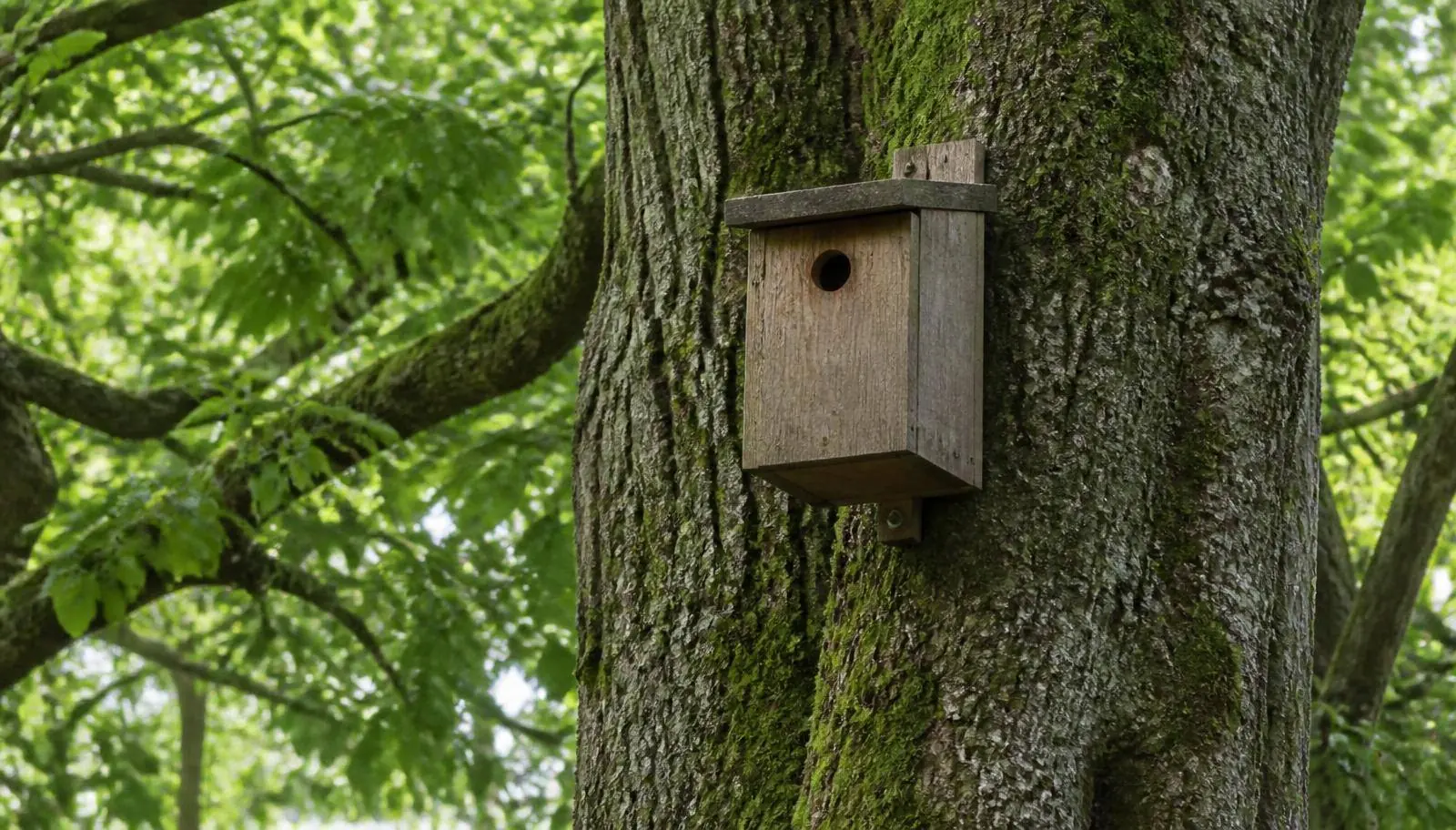
Bird box installation
A bird box nailed into bark at head height in the wrong aspect rarely gets used. We site boxes to suit the species you want to encourage, fix them with battens and straps rather than nails so the tree is not damaged and future chainsaw work stays safe, and, because we are usually already working in the canopy on other jobs, installation adds very little to a visit.
12 years working in trees across Surrey and Kent, 59+ five-star Google reviews, £10m employers' and £5m public liability cover.
12 yrs
Experience working in canopies across Surrey and Kent
£15m
Total insurance cover, £10m employers', £5m public and products
NPTC
City & Guilds certificates in tree climbing and aerial rescue
7 days
Typical wait for a free site visit, with the written quote the same day
The service
Bird box installation sounds simple, screw a box to a tree, but where it goes, how it is fixed and what species it is designed for all decide whether anything ever nests in it. A box hung too low, facing the wrong way or nailed straight into live bark will often sit empty for years, or worse, damage the tree as it grows around the fixing. Done properly, a box is matched to the birds you actually want to attract, mounted at the right height and aspect, and fixed in a way that neither harms the tree now nor causes a problem for anyone working on that tree with a chainsaw in ten years' time.
This service is for homeowners, landowners, schools, estates and anyone with mature trees who wants to support garden and woodland birds, whether that is a simple pair of blue tit boxes on a garden apple tree, or a wider scheme across a larger property near Sevenoaks or Bromley aimed at several species at once. It suits people who already have trees being worked on for pruning or reduction and want to add boxes to the same visit, as well as people who simply want boxes fitted properly by someone used to climbing.
The reason to have this done by a tree crew rather than fixed at ground level with a ladder is straightforward: getting a box to the right height and aspect in a mature tree, without damaging the bark or leaving a fixing that will girdle the branch as it thickens, is exactly the kind of work a climber does every day. Jack holds NPTC and City & Guilds certificates in tree climbing and aerial rescue, and the same £10m employers' and £5m public and products liability cover applies to this work as to any other job we do in a tree.
Homeowners, schools, estates and landowners across Surrey and Kent wanting to support nesting birds in mature trees.
Autumn and winter, outside the March–August nesting season, and ideally alongside other tree work already booked.
Species-appropriate box choice, correct height and aspect, and fixing with battens or straps rather than nails.
The tree itself, from a damaging fixing, and any bird already nesting, under the Wildlife and Countryside Act 1981.
What happens if it's left
A garden centre box hung on a whim usually goes wrong in one of a small number of predictable ways. It faces south or west into direct sun and rain, which most cavity-nesting birds avoid. It is hung too low, within easy reach of cats and squirrels, or too high to ever be checked and cleaned. It is nailed straight into the trunk, which damages the bark, invites decay in through the wound, and, as the tree grows, slowly swallows the fixing, turning a kind gesture into a hazard for whoever next has to climb that tree with a chainsaw.
There is also a legal dimension people rarely think about. Once a bird has started nest-building, that nest and its eggs are protected under the Wildlife and Countryside Act 1981, and it is an offence to intentionally damage, destroy or disturb it. That protection extends to work on the tree itself, not just the box, a badly timed pruning job in May can just as easily fall foul of the law as a poorly sited box. Anyone fitting boxes or working trees between March and August needs to check for active nests first.
The other quiet failure is maintenance. A box that is never cleaned out fills with old nesting material, parasites and debris, and becomes progressively less attractive to birds each spring. Left indefinitely, a decaying box fixed with nails can also become the exact hazard described above, a hidden metal fixing buried in wood that a chainsaw later meets without warning.
Boxes facing south or west into sun and driving rain are avoided by most species, years can pass with nothing using it.
Fixings driven into bark create an entry point for decay and get progressively buried as the tree grows around them.
A buried nail or screw in a stem is invisible until a chainsaw hits it, a real risk to whoever works that tree in future.
Disturbing an active nest between March and August is an offence under the Wildlife and Countryside Act 1981, whether from box fitting or tree work.
A 32mm hole meant for sparrows will not exclude larger birds from a box intended for blue tits, and predators can sometimes widen a poorly made hole.
Without an annual autumn clean-out, old nesting material and parasites build up and occupancy rates drop year on year.
What you get
Boxes go where they should be, up in the canopy at the right height, rather than wherever a ground-level ladder can reach.
Battens and straps distribute the load and flex as the branch grows, instead of a nail cutting a permanent wound.
No buried nails or screws left in the wood for a future chainsaw to meet without warning.
Hole size and box style matched to blue tit, great tit, house sparrow or open-fronted species like robins and wrens.
Fitting boxes while the crew is already up in the canopy for pruning or reduction work adds very little to the visit.
Any work near an active nest is checked first, keeping you clear of the Wildlife and Countryside Act 1981.
Bird box installation is a small job with a lot of detail underneath it. Getting the box, the height, the aspect and the fixing right is what separates a box that gets used for a decade from one that sits empty and is forgotten. Here is what actually goes into it.
Hole size is the single biggest factor in which species will use a box. A 25mm entrance suits blue tits and excludes larger competitors; 28mm opens the box to great tits as well; 32mm is sized for house sparrows, which nest in small loose colonies and often prefer boxes grouped a short distance apart rather than isolated. Robins and wrens will not use a hole-fronted box at all, they need an open-fronted design, sited lower and better hidden in cover such as ivy or a dense hedge line rather than in the open canopy.
Across gardens in Oxted, Caterham and Godstone, a mix of hole sizes on mature trees plus one or two open-fronted boxes tucked into hedging usually gives the widest range of species a reasonable chance. We talk through what is already visiting the garden before recommending a mix, since there is little point putting up a sparrow terrace where sparrows are never seen.
The general rule is 2 to 4 metres up, facing between north and east, so the box avoids the strongest afternoon sun and the worst of the prevailing rain from the south-west. A slight forward tilt helps rain run off the roof rather than in through the hole. Where possible, a clear flight line to the entrance, not screened by dense twigs right in front of the hole, makes it easier for adults to approach quickly, which matters once chicks are being fed.
Spacing matters for territorial species: blue tits and great tits will defend a nesting territory and do better with boxes spread around a garden rather than clustered on one tree, while house sparrows are the exception and are often happy with several boxes close together. Getting this right at the planning stage avoids boxes competing with each other for the same birds.
Nails and screws driven directly into a trunk or branch create a wound the tree has to compartmentalise, and as the wood grows in girth each year, a rigid fixing becomes buried, sometimes only two or three years later. That buried metal is a genuine hazard for anyone using a chainsaw on that tree in future, and it is one of the reasons we avoid nails entirely.
Instead, boxes are fixed with wide webbing straps or wooden battens that allow the branch to keep expanding without girdling, and that can be loosened or repositioned as the tree grows. It takes slightly longer to fit than a couple of nails, but it protects both the tree and whoever works on it next, including us, on a future visit.
Under the Wildlife and Countryside Act 1981, it is an offence to intentionally damage, destroy or take a wild bird's nest while it is in use or being built, or to disturb the birds while nesting. The practical nesting season runs from roughly March to August, though it can start earlier in a mild year, so any tree work or box fitting within that window means checking for active nests first. If a nest is found, the work is delayed until the birds have fledged.
This is one reason autumn and winter are the best time to fit new boxes, it gives them a full season to weather in and lose any strong scent of new timber before birds start prospecting for nest sites the following spring, and it avoids any risk of disturbing an active nest elsewhere in the same tree while fitting.
A well-made box in a reasonably sheltered position typically lasts several years before the timber needs replacing, but it needs an annual clean-out regardless of how sound it looks. Old nesting material harbours parasites that can put off the next occupants or harm chicks in a following brood, so each box should be opened and cleared in autumn, once the nesting season has fully finished and any young have fledged.
While cleaning, it is worth checking the fixing has not started to bind against the growing branch, that the roof still sheds water properly, and that the entrance hole has not been enlarged by a squirrel or woodpecker looking for an easy meal. A box that fails on any of those points is better replaced than patched, and if we are already doing other work in your trees, replacing a tired box costs very little extra.
Questions
Related work
A dense canopy blocking light or catching wind like a sail does not need a smaller shape, it needs less density.
Planting a tree that thrives in ten years' time starts with picking the right species for your soil, not the nicest one in the nursery photo.
Dead and hanging limbs don't announce themselves before they fail.
We cover Oxted, Westerham, Edenbridge, Sevenoaks, Biggin Hill, Bromley, Tunbridge Wells, Redhill and the surrounding villages, see the towns our tree surgeons cover across Surrey and Kent, browse all tree surgery services, read about Jack and the crew, or go straight to the free tree surgery quote form.
Free quote
Send the form or call and we will book a free site visit, usually within 7 days, talk through which species suit your garden or land, and send a written quote the same day, fitted with battens and straps, not nails, so your trees stay undamaged.
Call 07375 701290Five Pebble Hill Cottages, Westerham Road, RH8 0EA · Mon–Sat 8am–9pm · Sunday closed